ABANILLA CASTLE
The so-called Castillo de Abanilla (Castle of Abanilla) is a historical fortification located in the urban center of the town of Abanilla, in the northeast of the Region of Murcia, of which only very few and deteriorated remains are preserved today. It is a medieval castle whose main function was the defense and control of the surrounding territory, as well as the protection of the population that developed around it. As is the case with many fortifications in the southeastern peninsula, its origin is linked to the period of Islamic domination, although the building gained special prominence during the Late Middle Ages under Christian rule.
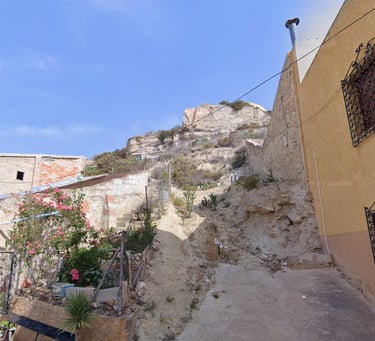
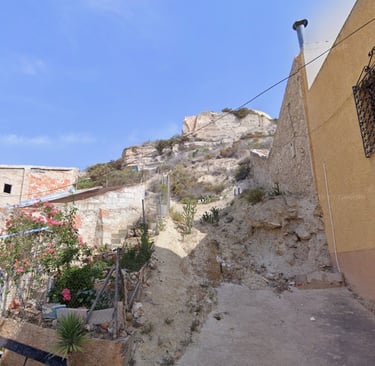
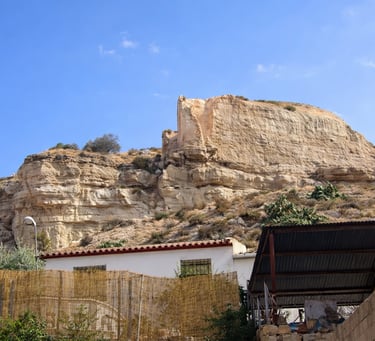
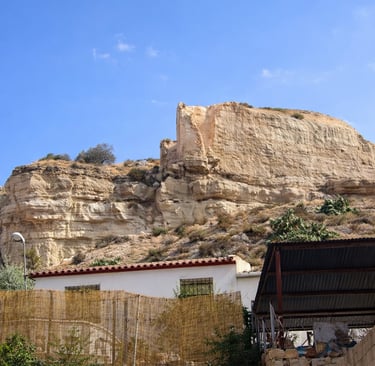
The remains of the castle are found in the last southwestern foothill of the Abanilla mountain range, on a small isolated hill that rises approximately fifty meters above the immediate surroundings. This location responds to a very common strategic criterion in medieval fortifications: visual control of the territory and communication routes. From this elevated position, a large part of the surrounding landscape can be dominated, including the meadow of the Chícamo River, a torrential watercourse that flows approximately one and a half kilometers to the west of the population.
The elongated shape of the hill, which reaches about three hundred meters in length in an east-west direction and around one hundred meters in width in a north-south direction, conditioned both the layout of the castle and the subsequent development of the urban center. In fact, the historic village of Abanilla was formed around this elevation, especially on its northern slope, while the more modern sectors of the population extended to the south. In the high area, near the ancient castle, some homes excavated in the rock of the hill, known as cave houses, can still be observed, constituting a unique element of the urban landscape.
📷 Ramón Sobrino Torrens
History
The first documentary references to Abanilla in the Islamic period are scarce, although it is known that during the 12th century the Andalusian geographer al-Idrisi mentioned the locality—then called al-Banyala—due to the quality of the fabrics produced there, which were even exported to territories of the Islamic East. It is likely that during this period there was some type of fortification on the hill where the castle now stands, although the documentary news becomes more precise after the Christian conquest of the territory.
At the beginning of the 13th century, Abanilla was a small village dependent on the district of Orihuela, and its castle appears cited in various Christian sources after the incorporation of the territory into the Crown of Castile in the mid-century. In the medieval documentation, the place is mentioned with names like the castle of Hauaniella or the castle of Fabanella. The fortress then played a fundamental role as a territorial control and defense element in a border area that was still unstable.
After the suppression of the Mudéjar rebellion in the Kingdom of Murcia in 1266, King Alfonso X the Wise granted the villa and its castle to the Aragonese nobleman Guillén de Rocafull. For more than two centuries, the Rocafull family held the lordship over Abanilla, until in 1462 the territory passed into the hands of the Order of Calatrava, one of the main military orders of the Crown of Castile. Under the dominion of this institution, which lasted for nearly four centuries, the fortress continued to be a key element in the organization of the territory.
By the end of the Middle Ages, the castle was in good condition. The population of Abanilla, which then had approximately a hundred houses, was situated protected by a walled enclosure on the northern slope of the hill. The fortress constituted the core of the local defensive system and symbolized the lordly power over the village and its territory.
The urban evolution of Abanilla during the Modern Age profoundly transformed this landscape. After the expulsion of the Moriscos at the beginning of the 17th century and the subsequent demographic growth of the 18th century, the population began to expand beyond the limits of the old medieval enclosure. Over time, the castle progressively lost its defensive function and began a process of abandonment. The disappearance of the direct oversight of the Order of Calatrava in the 19th century accelerated its deterioration, so that by the middle of that century the fortress was already in ruins and partially dismantled.
The space occupied by the castle has undergone various transformations in contemporary times. Part of the eastern area of the hill was altered by the construction of a large water reservoir intended for the supply of the population, while the western sector became a public park following a series of leveling works. In this last area, a monument dedicated to the Sacred Heart of Jesus was erected, which today constitutes one of the most visible elements of the hill. Despite these alterations, some remnants of the original structures of the fortress are still preserved.


The Cross of Calatrava is the main symbol of the military order that administered Abanilla for centuries.
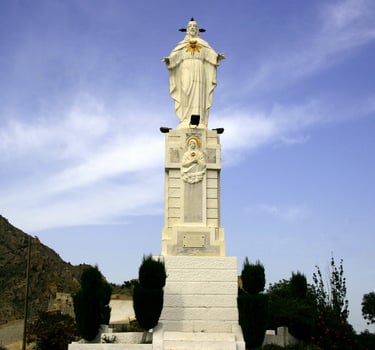
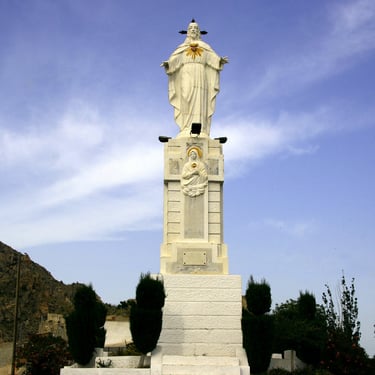
Monument to the Sacred Heart of Jesus located on the hill where the castle stood since 1946. 📷 Ramón Sobrino Torrens
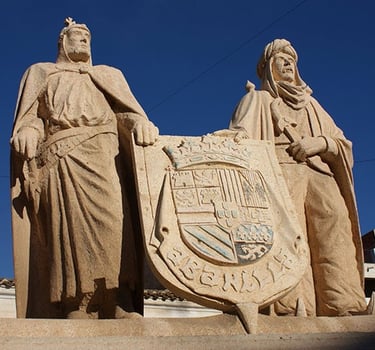
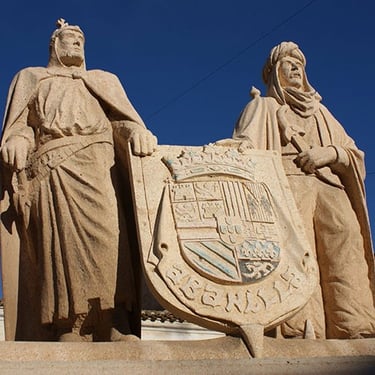
Monument in the center of Abanilla that commemorates the Muslim and Christian past of the town. 📷 Turismo Región de Murcia.
Analysis of the remains
The archaeological investigations carried out at the site allow for a partial reconstruction of the layout of the castle. The fortress occupied the upper part of the eastern sector of the hill and presented an oval-shaped plan, with an approximate length of one hundred meters in the east-west direction and a width close to seventy-five meters in the north-south direction. This type of layout, adapted to the morphology of the terrain, is common in medieval fortifications built on natural reliefs.
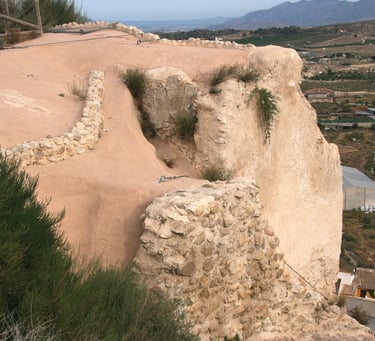
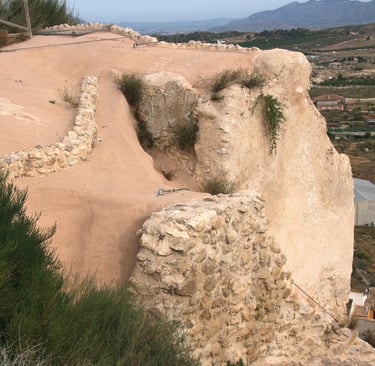
Currently, some remains of the wall sections are preserved. One of the most significant corresponds to the southeast sector of the enclosure, where a section of wall approximately twenty-five meters long and with an average height close to six meters remains standing. This wall was built on a strong masonry plinth, while the elevation was constructed with rammed earth, a technique very common in medieval military architecture in the southeastern peninsula. The wall was originally covered with a mortar plaster that has practically disappeared today.
At the northern end of the enclosure, remains of another wall section are also preserved, of lesser significance, built with rammed earth mortar. This wall, about seventeen meters long and around one meter wide, barely exceeds two meters in height at its best-preserved points. Archaeologists interpret that this sector housed the main access door to the castle, which likely connected with the path that ascended from the current Calle del Castillo, in the historic part of the urban nucleus.
Given the fragmentary state of the preserved remains, it is difficult to reconstruct the internal organization of the enclosure with precision. However, it is likely that the castle housed the typical dependencies of this type of medieval fortifications: residential spaces for the warden or feudal representative, storages, cisterns for water supply, and areas designated for the military garrison. The layout of these elements would have been conditioned by the shape of the hill and by the need to make the most of the available space within the walled enclosure.
From a historical and artistic perspective, the castle of Abanilla fits within the broad group of medieval fortifications in the southeastern peninsula, many of which had their origin in Islamic times and were subsequently adapted or reused after the Christian conquest. Its construction system based on rammed earth and its location on a strategic hill respond to the typical characteristics of military architecture developed in the ancient Kingdom of Murcia between the 12th and 15th centuries. Although it is not a fortress of great size or special monumentality, its importance lies in its role within the process of organization and control of the territory in the Middle Ages. The castle acted for centuries as the main defensive and administrative point of Abanilla, marking the location of the urban nucleus and conditioning its subsequent development.
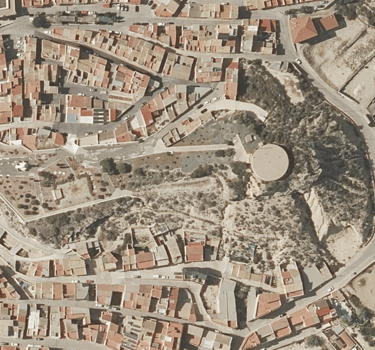
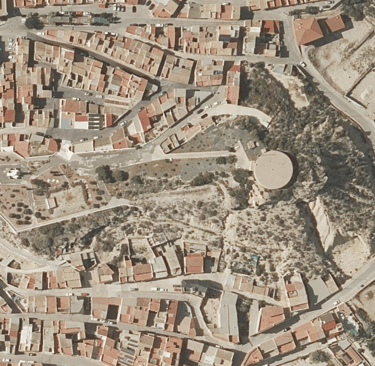
Satellite image of the hill next to the town of Abanilla on which the castle was located. 📷 IGN