Epicospal Palace (Murcia)
The Episcopal Palace is located in Murcia, in the heart of the historic center, forming part of the most representative enclave of the city: the square of Cardinal Belluga. In front of the main façade of the cathedral, the building is part of an urban complex of great symbolic and monumental value. To the south, the palace also opens to the Glorieta de España and the Segura River. Furthermore, it occupies a place filled with historical memory, linked since the Islamic period to the power structures that articulated the city.
The current building was constructed in the 18th century, approximately between 1748 and 1768, within the context of urban renewal promoted after the completion of the new façade of the cathedral.
It is a prominent example of Rococo, with Italian and French influences, especially visible in its decoration. The promotion of the building was the responsibility of Bishop Juan Mateo López.
Concerning its authorship, several masters intervened throughout the construction process. Among them, José López stands out, who directed an important phase of the works, and Baltasar Canestro, who contributed to the definitive configuration of the building and its ornamental character. The pictorial decoration of the main façade is attributed to Italian painter Paolo Pedemonte, the author of the mural compositions that characterize the ensemble.
Cardinal Belluga Square, where the palace is located, is one of the key landmarks of our "Best of Murcia" walking tour. It's the best way to ensure you don't miss any detail of the monumental artistic ensemble surrounding this enclave, considered the heart of the city.
History
The site of the current palace has an origin that predates the building we contemplate today. During the Islamic period, it was part of the Alcázar Mayor, integrating into the palatial complex of the city. After the Christian conquest, this space was designated for episcopal residence, a function it has maintained over the centuries.
The ancient palace, developed between the 13th and 16th centuries, had an irregular structure, the result of successive expansions and an organic spatial organization, inheriting Islamic and Mudejar construction traditions.
In the 18th century, the construction of the new facade of the cathedral prompted a comprehensive transformation of the surroundings. As part of this process, it was decided to erect a new episcopal palace in keeping with the monumentality of the ensemble. To this end, previous buildings were demolished, and a completely new building was projected in front of the cathedral.
The works were developed in several phases. Initially, local masters linked to the construction of the cathedral participated, such as Pedro Pagán, José Alcani, or Martín Solera. Subsequently, the direction was taken over by José López, a disciple of Jaime Bort, the architect of the cathedral facade. Finally, the Italian architect Baltasar Canestro introduced the definitive solutions, especially in decoration and in the final configuration of the building, which was completed in 1768.
Throughout its history, the palace has been the scene of relevant episodes. During the War of Independence, it was used as a headquarters by French troops. In the 19th century, it hosted the royal family on various visits, and during the cantonal revolution of 1873, it was used as the headquarters of the revolutionary Junta.
Description
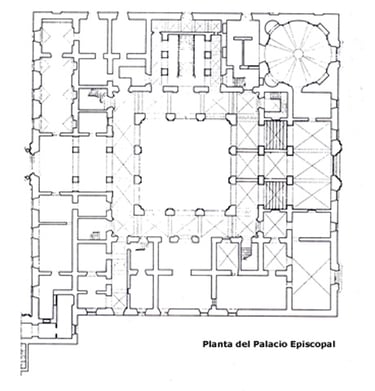
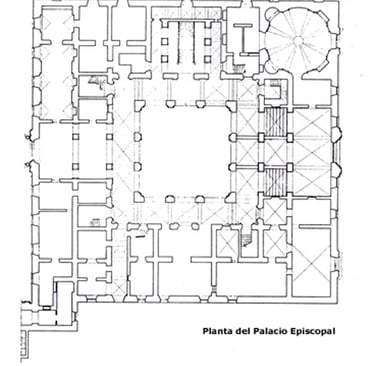
The Episcopal Palace presents a square plan organized around a central courtyard, with a moderate height development and a clear volumetry. This structure responds to an ordered and representative conception, typical of the institutional architecture of the 18th century, although enriched by a decoration that adds dynamism and movement to the whole.
Exterior
The building has two main facades, each with a differentiated character.
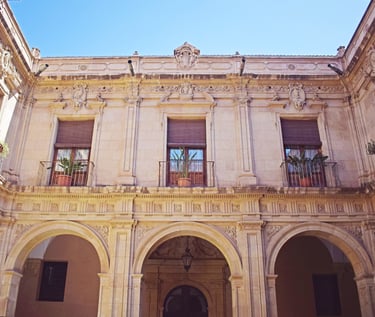
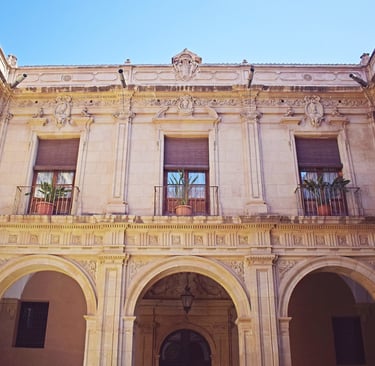
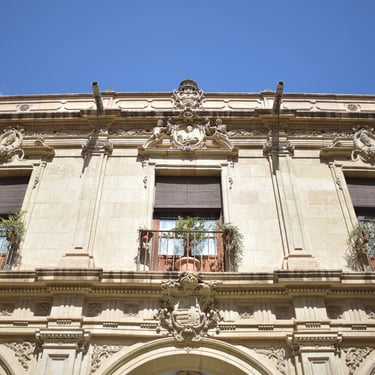
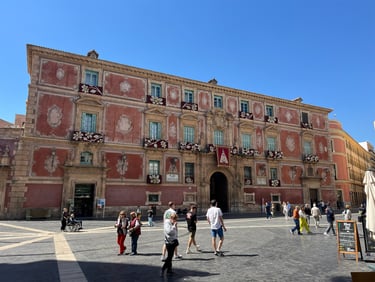
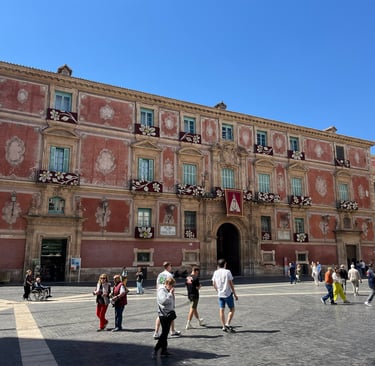
The facade facing the square of Cardinal Belluga is the most representative. It features a central entrance arch that is slightly flared, flanked by decorated Ionic pilasters with episcopal emblems. Above this access is a large institutional balcony presided over by the coat of arms of Bishop Diego de Rojas y Contreras, which acts as the compositional axis of the entire facade.
On both sides there are doors, one of which provides access to the palace chapel. The entire ensemble is enriched with a decoration that combines sculptural elements (coats of arms, moldings, reliefs) with a distinctive pictorial decoration that covers the walls. These paintings, organized in panels with rocaille, cornucopias, and fictitious moldings, generate a tapestry effect and constitute one of the most original features of the building.
The rear facade, facing the Glorieta and the river, presents a more open composition. Its entrance is organized through a central access flanked by columns, above which is a balcony with a wrought iron railing, topped by the corresponding episcopal coat of arms.
In this front, the so-called "Hammer" stands out, an angled body that juts out towards the river. Conceived as a lookout, it allowed the bishop to contemplate the landscape of the Segura and the gardens of the promenade, while also serving as an urban closure element for the Glorieta.
Interior
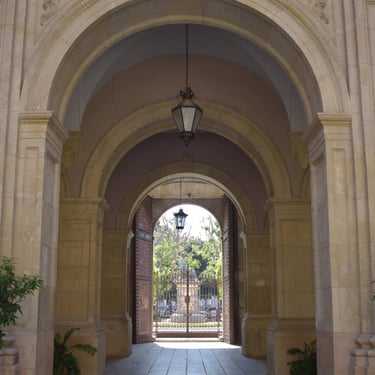
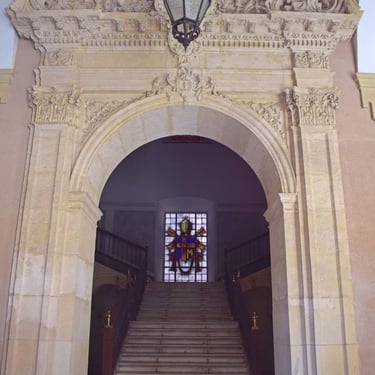
The interior is articulated around a courtyard or cloister of two levels. The lower body features semi-circular arches supported on Tuscan pilasters, while the upper one introduces Ionic pilasters and balconies that provide greater visual lightness.
In these balconies appears one of the most interesting decorative elements: a series of stone medallions with effigies of bishops, integrated into the parapets. These representations reinforce the institutional character of the building, incorporating into the architecture the historical memory of the diocese.
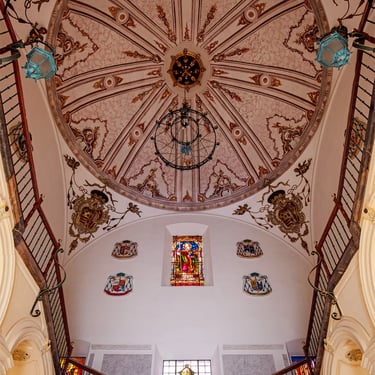
From the cloister begins the main staircase, which leads to the noble floor, where the representative dependencies are located.
Among the interior spaces, the chapel stands out, with a circular plan, decorated with Corinthian pilasters and a rococo cornice, an example of the integration between architecture and ornament characteristic of the building.
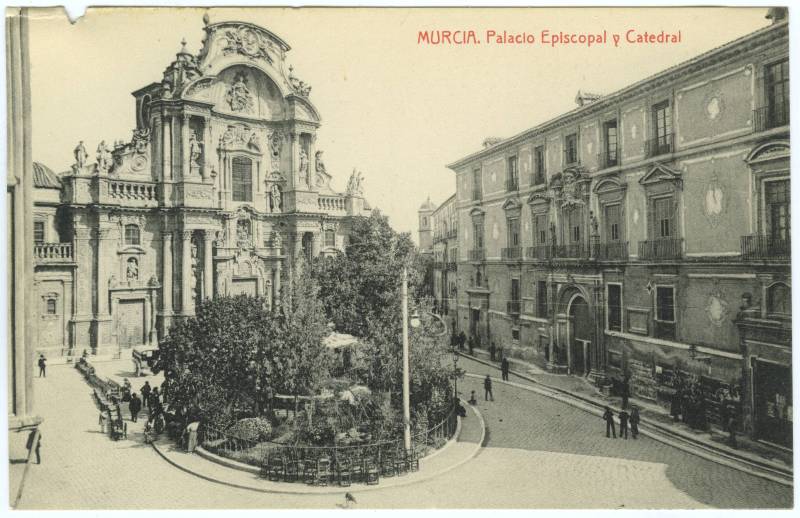
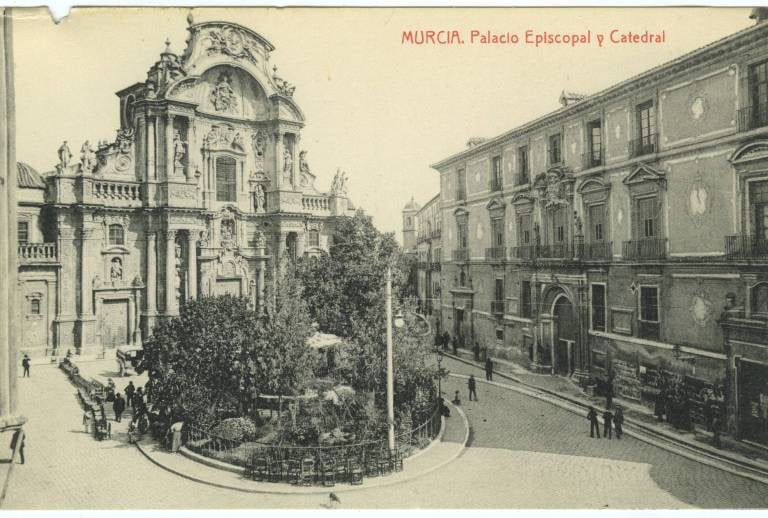
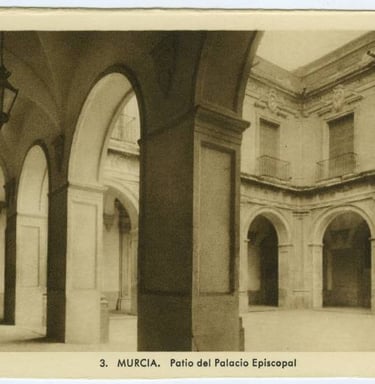
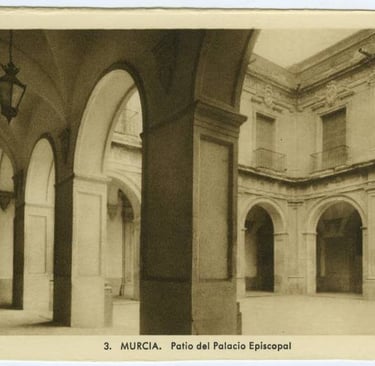
Old postcards with images of the episcopal palace of Murcia. The first is from around 1911 and the second from around 1930. General Archive of the Region of Murcia.
Visit
The Episcopal Palace is currently the seat of the Diocese of Cartagena, so access to the interior is limited to the cloister and conditioned to institutional activity. Nevertheless, its external contemplation is free and constitutes one of the essential experiences of the historical center of Murcia.
For updated information, you can consult the official website of the Bishopric of Cartagena.
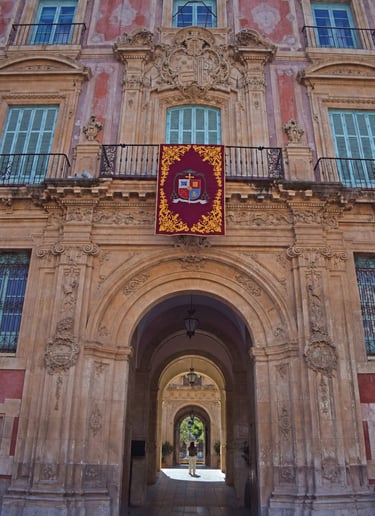
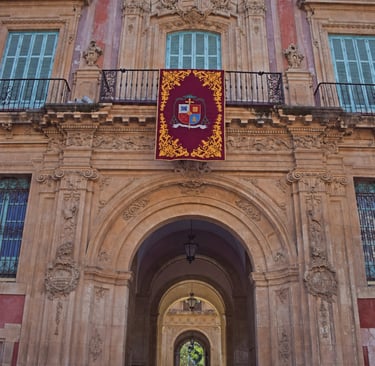
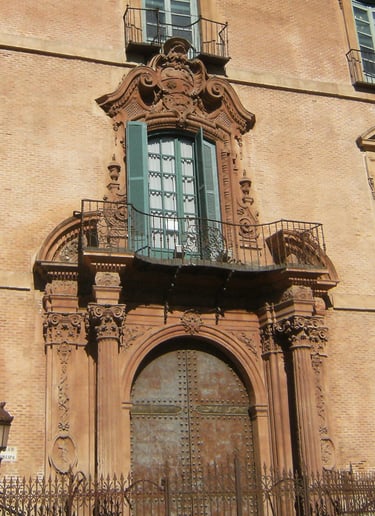
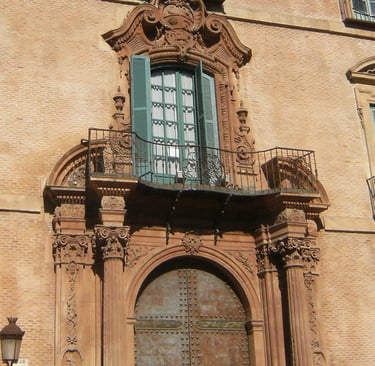
Main cover of the episcopal palace, towards Cardenal Belluga square.
Cover of the episcopal palace towards the Glorieta de España.