
MURCIA CATHEDRAL
The Cathedral of Saint Mary of Murcia is the main temple of the city and, probably, the most recognizable monument in the entire Region of Murcia. Furthermore, it is a work constructed over more than four centuries, a building where the political, religious, and artistic history of the ancient Kingdom of Murcia has been written in stone. Its current image is the result of a slow layering of styles, masters, and projects that transformed an ancient Islamic mosque into one of the most unique cathedrals of the Spanish Mediterranean.
Few Spanish cathedrals show so clearly the evolution of peninsular architecture between the late Gothic and the full Baroque. The Cathedral of Murcia still preserves the structural sobriety of Castilian Gothic, incorporates some of the most significant Renaissance works of the Spanish 16th century, and culminates externally with one of the most spectacular Baroque façades in Europe.
Here we offer you some interesting facts about the history and artistic values of our cathedral, although the best option to truly know it is to book one of our guided tours of the Cathedral of Murcia . Always accompanied by an official guide, an expert in history and artistic heritage.
The ancient Islamic main mosque
The origin of the temple dates back to the very heart of Andalusian Murcia. On the site where the cathedral now stands, the main mosque of the Islamic city, the principal religious building of the medina founded in the 9th century by Abderramán II, was erected.
After the Castilian conquest of the Kingdom of Murcia in the 13th century, the mosque was consecrated to Christian worship under the invocation of Santa María. For decades, as happened in many peninsular cities, the ancient Muslim building continued to be partially used while being adapted to Christian liturgical needs.
Even today, beneath the cathedral museum and some adjoining facilities, archaeological remains of that main mosque are preserved. The walkway of the current Cathedral Museum allows one to contemplate part of these structures, turning the journey into an authentic trip to the historical origins of Murcia.
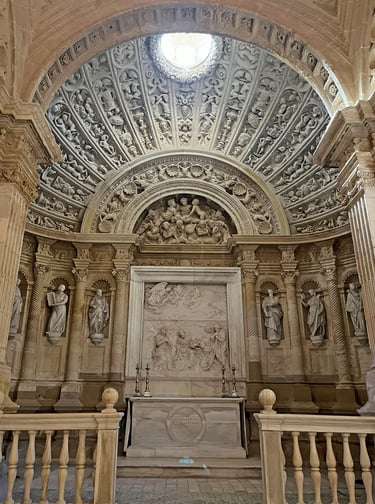
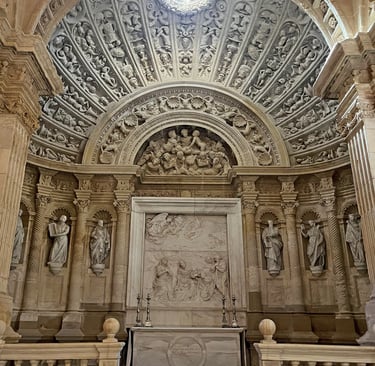
La capilla de Junterón, cuya construcción se inicia hacia 1515, es uno de los primeros espacios renacentistas en la historia del arte español.
The construction of the Christian cathedral
The first attempts to build a large cathedral began in the 14th century. Bishop Pedro Peñaranda initiated a new church around 1320 after definitively demolishing the remains of the Islamic mosque, although that first project was never completed.
The definitive construction officially began on January 22, 1394, when Bishop Fernando de Pedrosa laid the first stone of the current building. Unlike other large Castilian cathedrals built in contexts of great economic prosperity, the Murcia cathedral progressed slowly and with limited resources. This circumstance partly explains the relative sobriety of its original Gothic structure.
The work was essentially completed in the 15th century. In 1462, the vaults of the temple were closed, and a few years later, during the papacy of Lope de Rivas, the cathedral was finally consecrated.
Architecturally, the Cathedral of Murcia belongs to the last Castilian Gothic style, although it shows a significant influence from Mediterranean and Catalan Gothic. It has a Latin cross plan, three naves, an ambulatory, and side chapels opened between the buttresses. However, the exterior perception of the building was deeply altered by the major reforms of the subsequent centuries.
The Renaissance and the monumental transformation of the cathedral
The 16th century was one of the brightest moments in the artistic history of Murcia. The economic boom of the Kingdom and the strength of the chapter propelled a profound renewal of the cathedral, which went from being an essentially Gothic building to becoming a great laboratory of the Spanish Renaissance.
During this period, some of the most important architects of the time worked, especially Jacobo Florentino, disciple of Michelangelo, and Jerónimo Quijano, a key figure of the Murcian Renaissance.
Many of the masterpieces of the temple are owed to them: the first bodies of the tower, the facade of the Sacristy, the Chapel of Junterón, the Chapel of Baptism, and various interior reforms. The Renaissance introduced new spatial conceptions, classicist decoration, Italianate repertoires, and a sculptural richness unknown until then in Murcia.
The result was an extraordinarily complex cathedral, where medieval Gothic began to coexist with Plateresque and Renaissance classicism.
The monumental gates of the Cathedral
The Gate of the Apostles: the great Gothic access
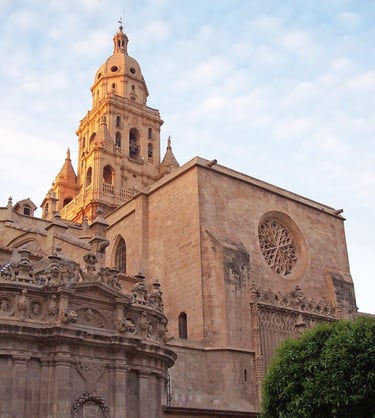
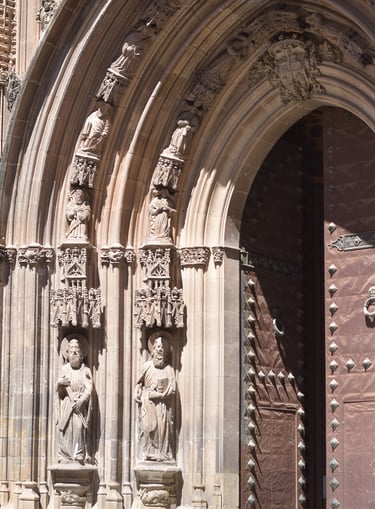
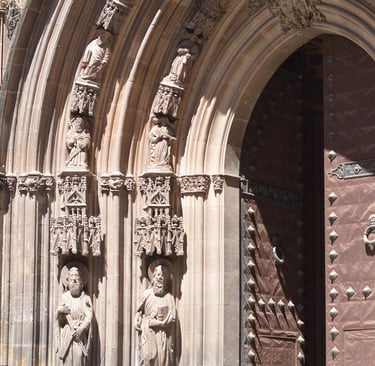
The Gate of the Apostles (Puerta de los Apóstoles), located on the south facade, is the most important medieval access preserved in the cathedral. It began construction in 1463 and was completed in 1488 in Gothic style.
The entrance features an elegant conopial arch decorated with archivolts and sculptures. On both sides, the images of Santiago, San Pedro, San Andrés, and San Pablo appear, who gave the door its name.
Above the whole scene stands the magnificent flamboyant rose window that illuminates the interior crossing. The shield of Isabel II added later recalls the financial support provided by the queen after the devastating fire of 1854.
This door is the meeting point for our guided tour of the Cathedral of Murcia. Don't hesitate to book if you want to learn in-depth about the monumental heart of the city.
The Gate of the Chains: the triumph of Plateresque
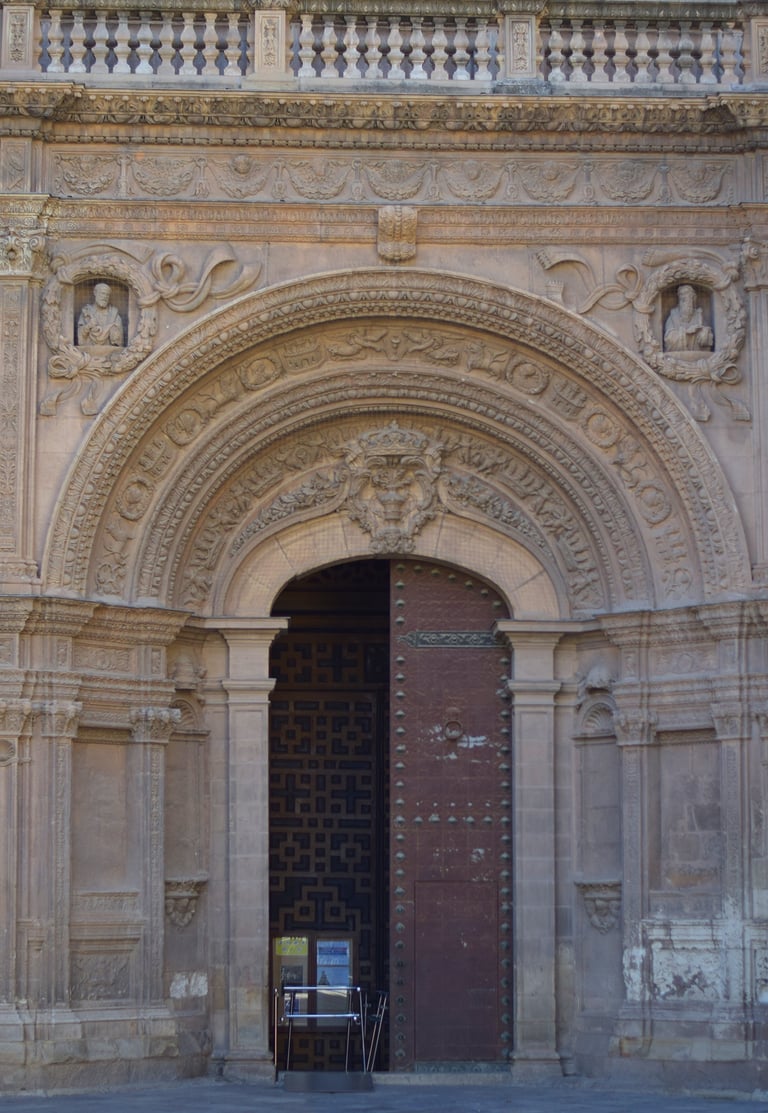
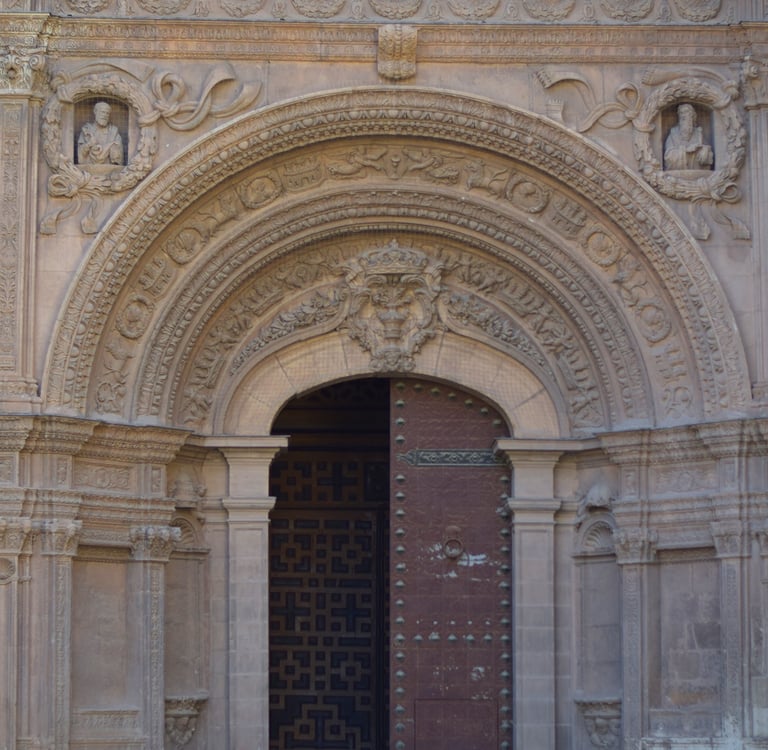
The northern façade houses the renowned Gate of the Chains (Puerta de las Cadenas), one of the first manifestations of Renaissance Plateresque in southeastern Spain.
Its lower body, constructed in the early 16th century and attributed to Juan de León, features a monumental semicircular arch decorated with medallions, classical busts, cherubs, and vegetal motifs.
The iconographic program exalts the conquest of Granada by the Catholic Monarchs and the religious unity of the Hispanic monarchy. In the spandrels appear Saints Peter and Paul, while the upper body incorporates images of the Cartagenese saints and a representation of the Virgin.
The name of the door originates from the chains that surround the cross located in front of the entrance.
The Baroque façade: the grand front of Jaime Bort
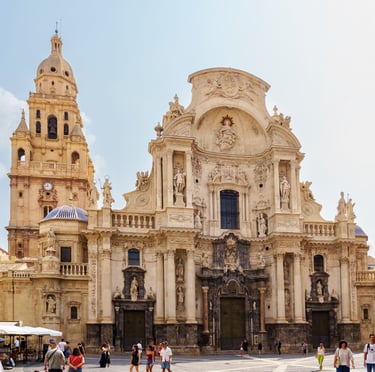
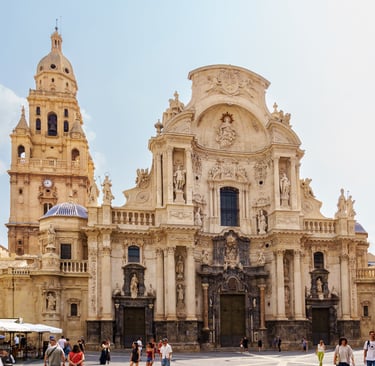
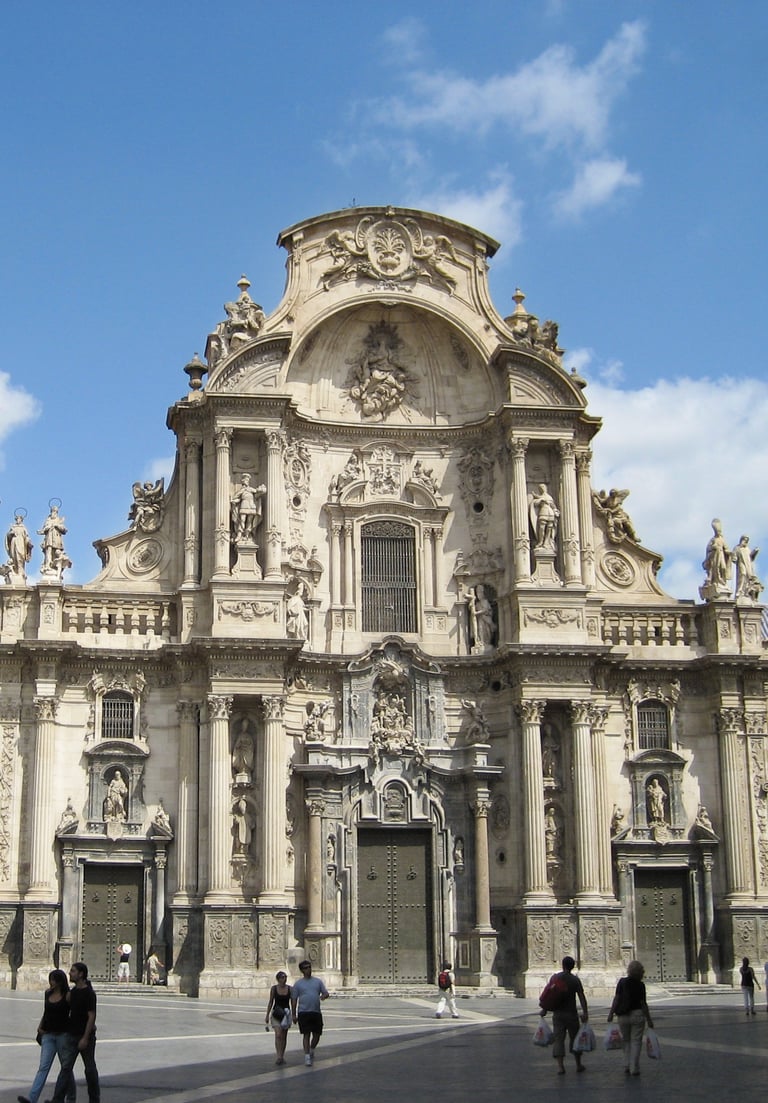
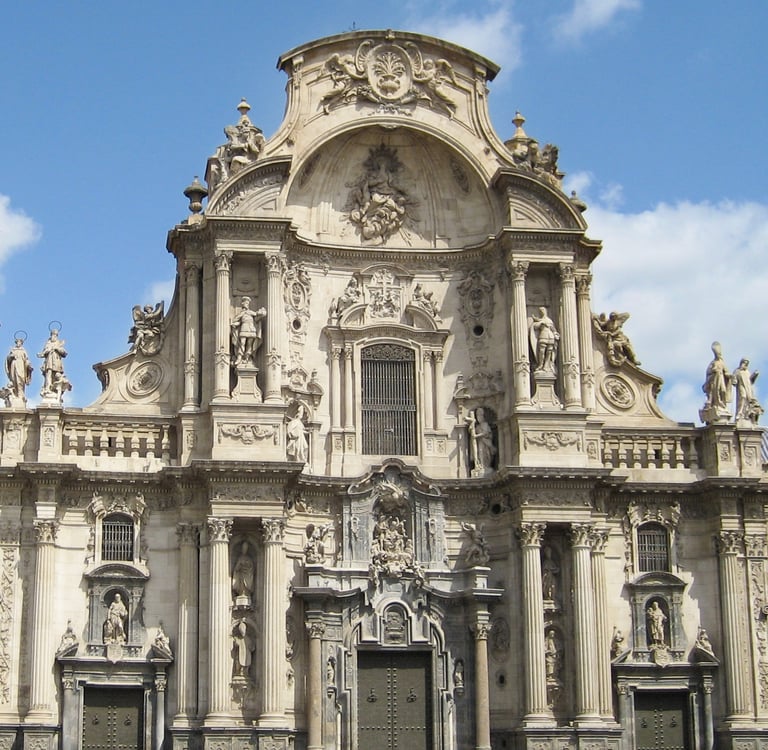
The main façade of the Cathedral of Murcia constitutes one of the culminating works of Spanish Baroque of the 18th century.
The old Renaissance doorway suffered serious structural problems due to earthquakes, floods, and foundation deficiencies. It was finally demolished in 1732 and replaced by the monumental front designed by Jaime Bort, with technical intervention from the engineer Sebastián Feringán.
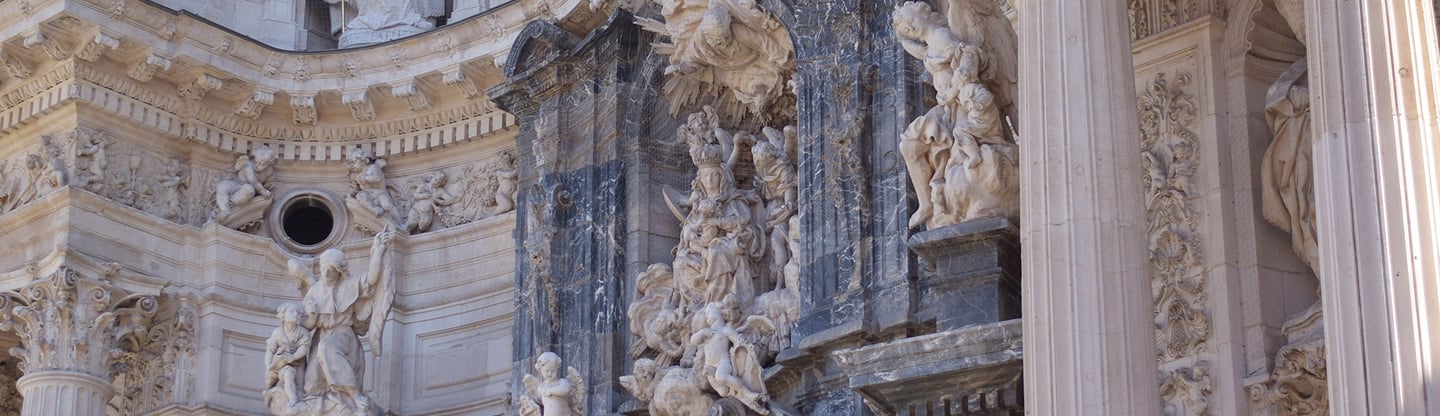
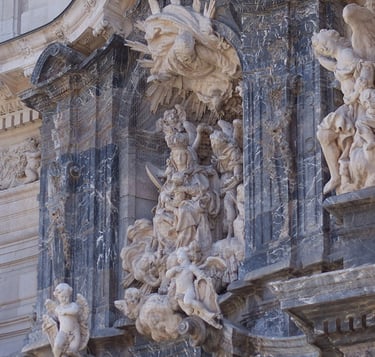
Constructed between 1737 and 1754, the façade was conceived as a gigantic stone altarpiece dedicated to the Virgin Mary and the glories of the diocese of Cartagena.
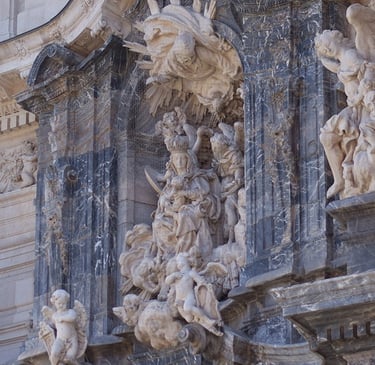
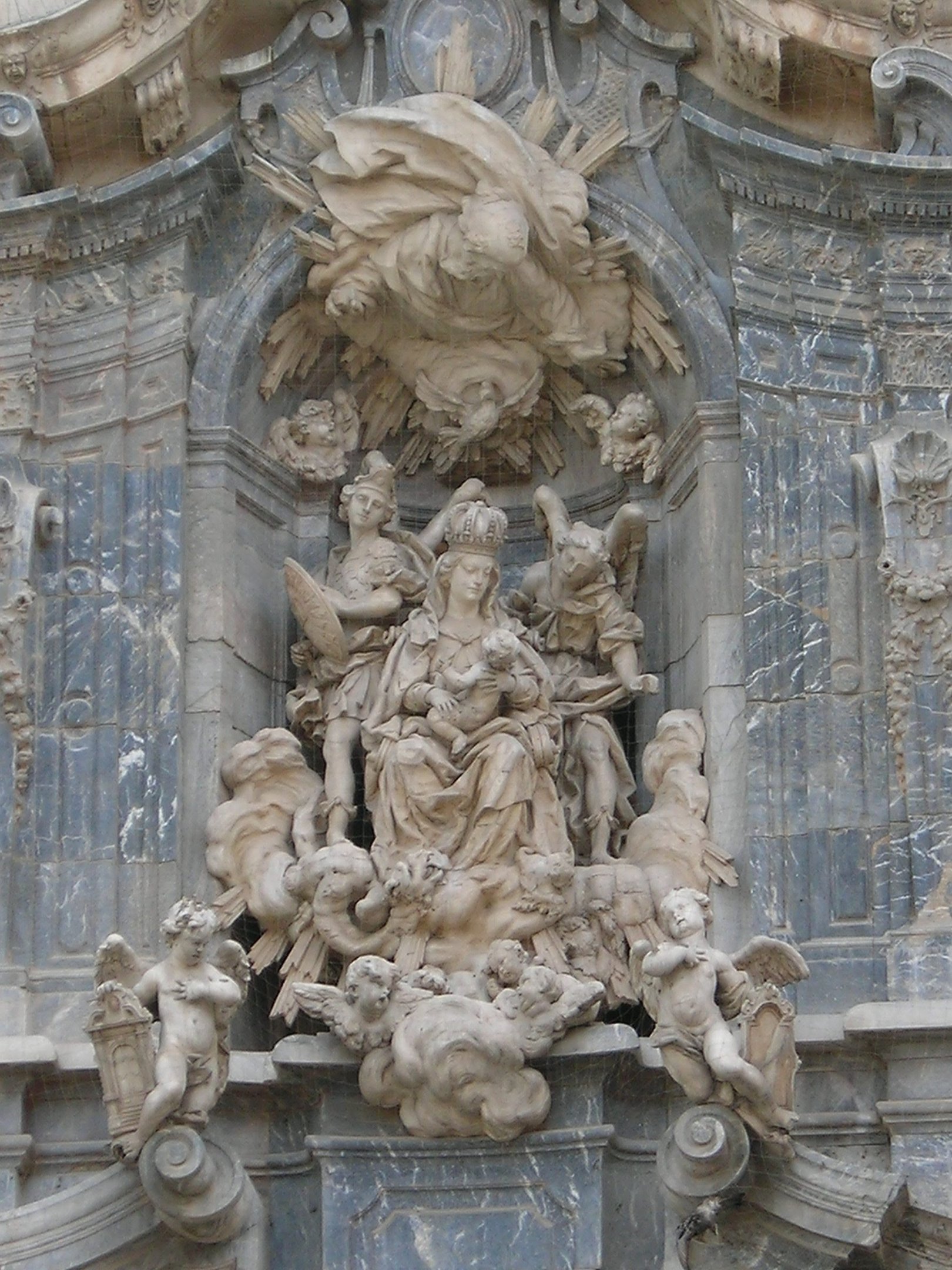
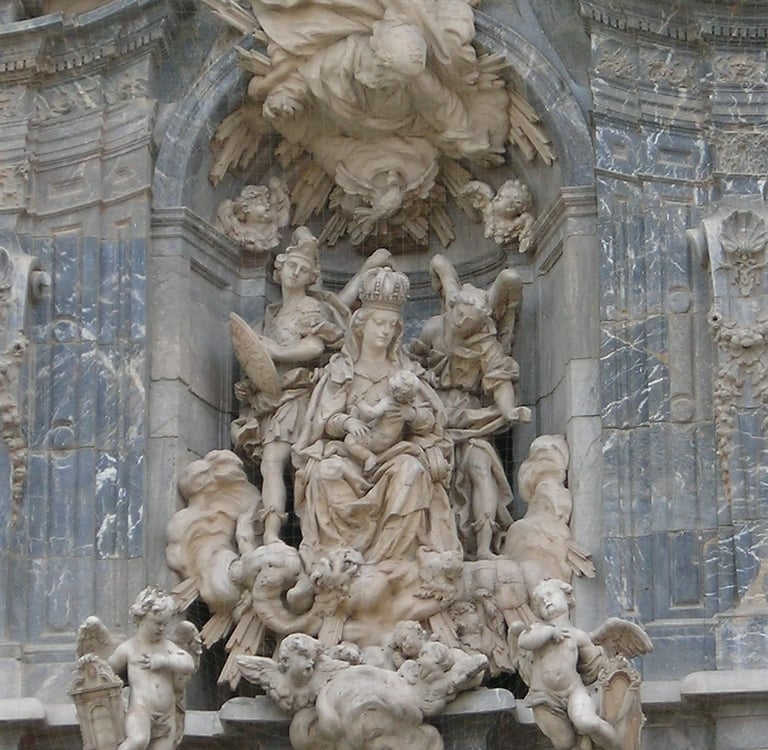
The sculpture here ceases to be a mere architectural complement and becomes the absolute protagonist. Saints, apostles, archangels, bishops, and kings form a complex theatrical scenography where the Assumption and Coronation of the Virgin stand out.
The dynamism of the lines, the play of lights and shadows, the indentations and projections, the enormous columns, and the ornamental exuberance make this façade one of the peaks of Mediterranean European Baroque.
Its relevance in the history of Spanish Baroque is enormous: it represents practically the last great baroque front raised in Spain and one of the most brilliant syntheses between architecture and monumental sculpture.
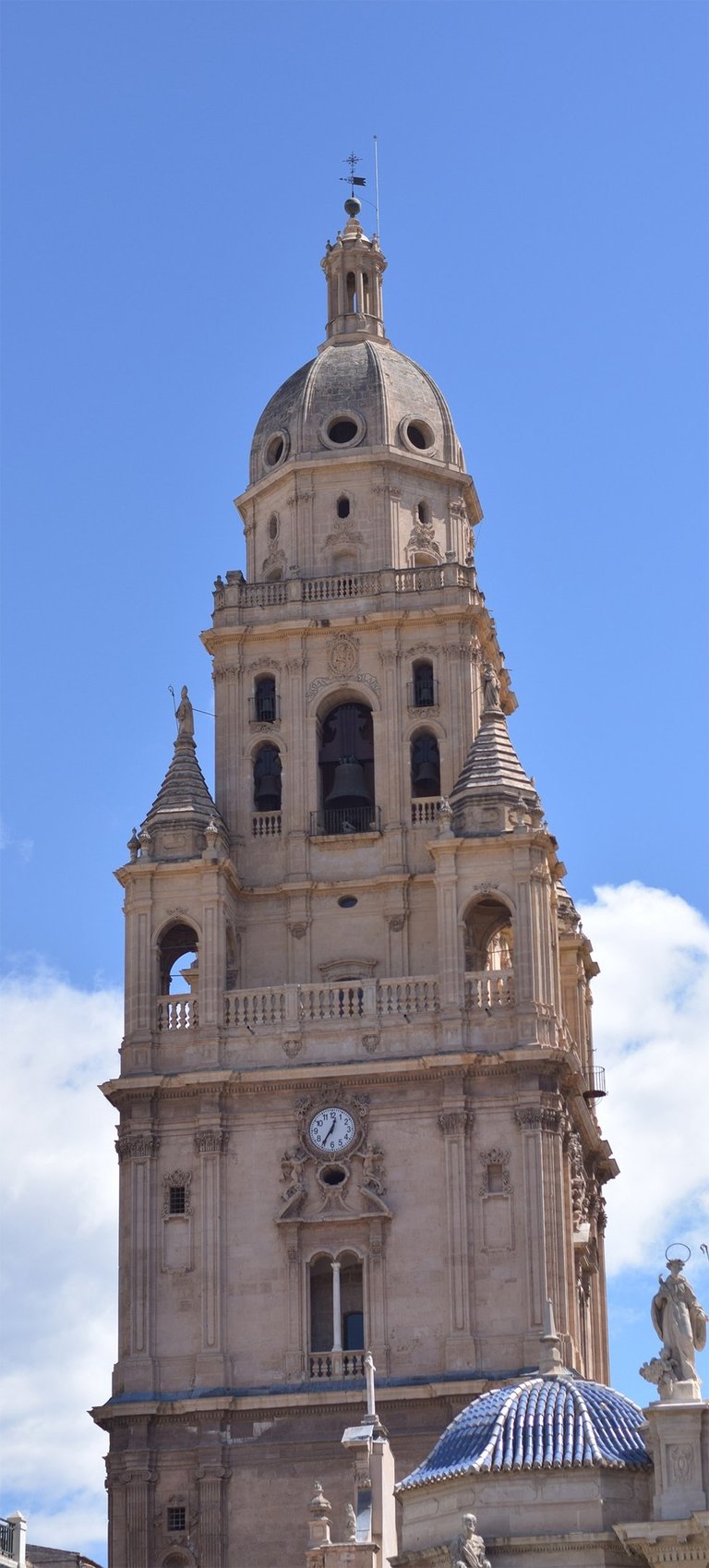
The Bell Tower of the Cathedral of Murcia
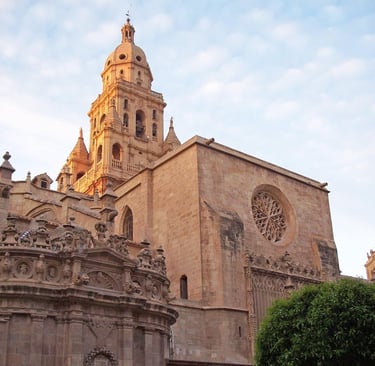
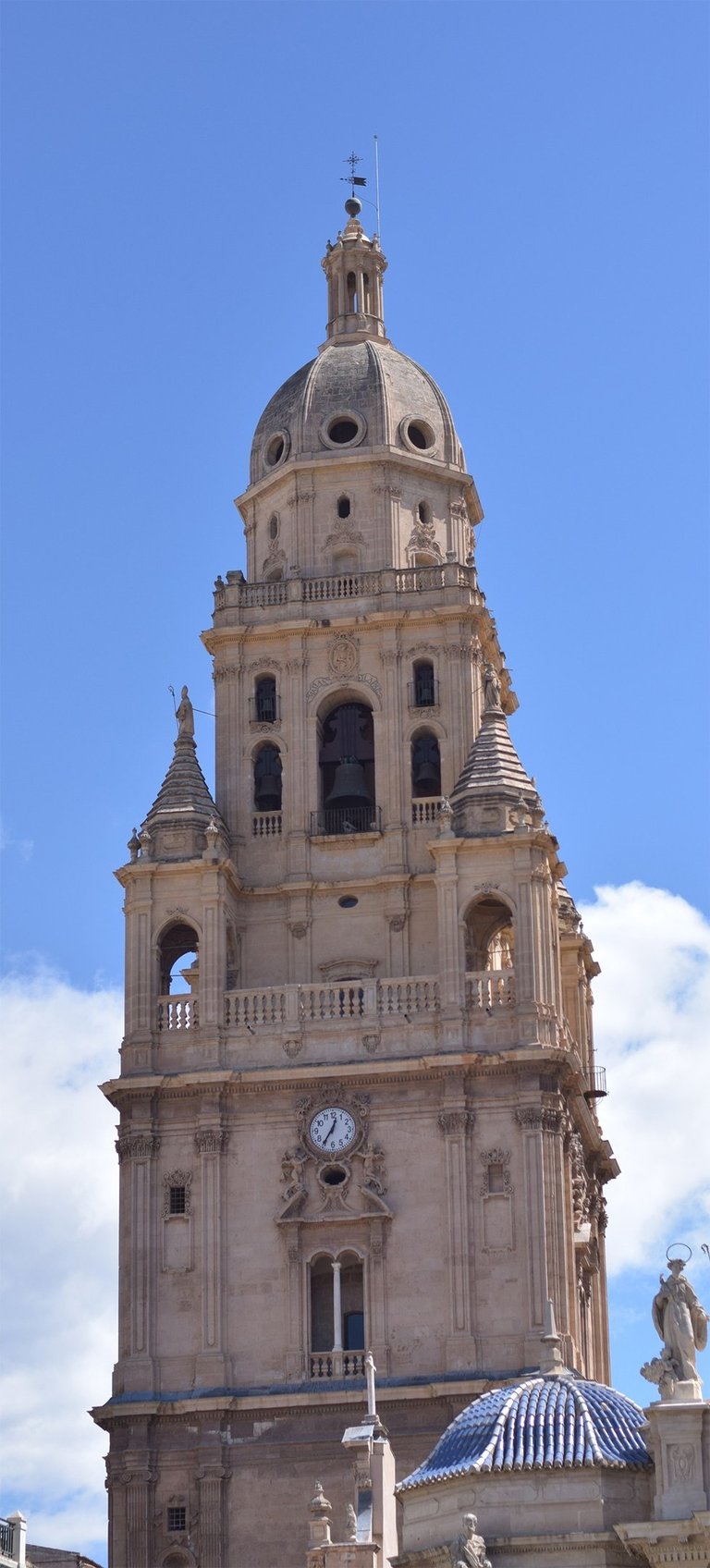
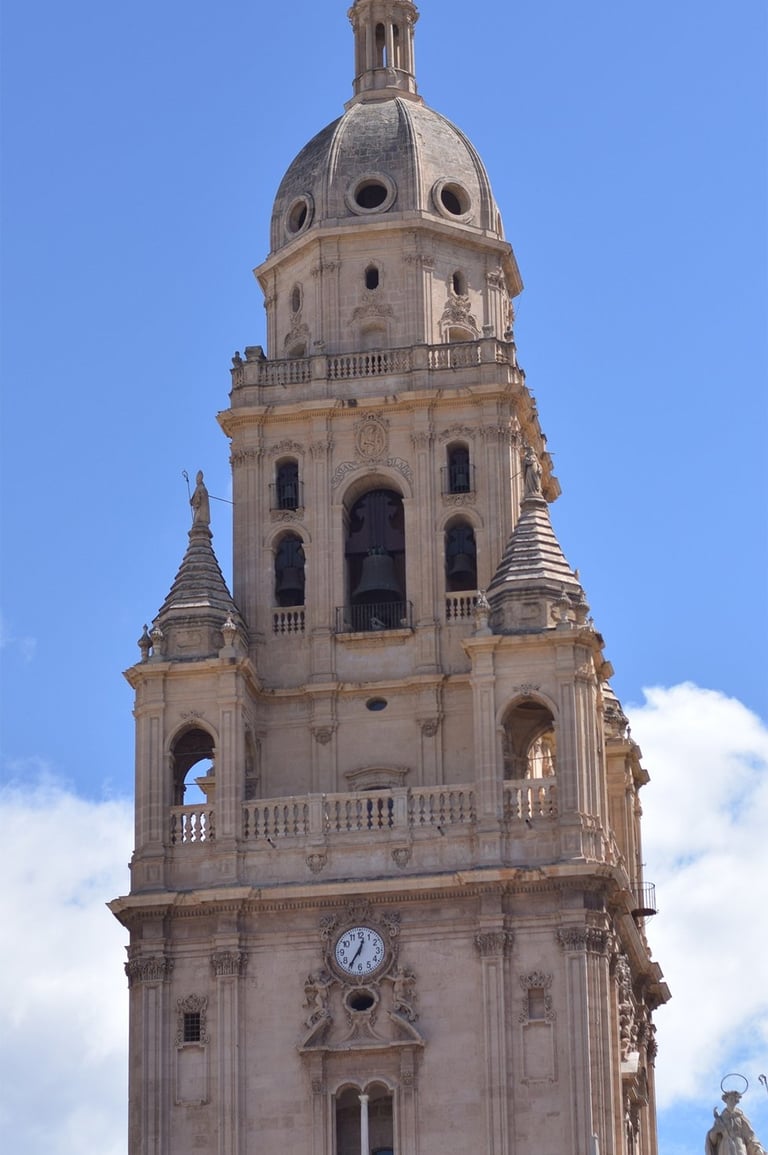
The bell tower is the great vertical symbol of Murcia and one of the most important bell towers in Spain. At 93 meters tall, 95 with the weather vane, it was for centuries the tallest building in the entire region.
Its construction began in 1519 and was not completed until 1793, a circumstance that explains the extraordinary mix of styles it presents.
The first body corresponds to Jacobo Florentino and represents one of the earliest examples of Spanish Renaissance. The second body was designed by Jerónimo Quijano and maintains the plateresque refinement of the whole.
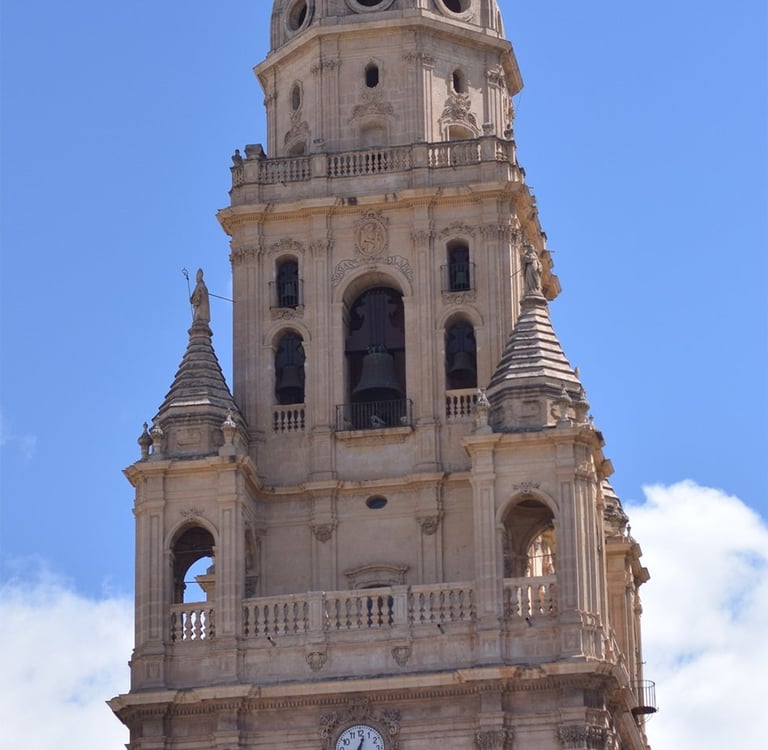
After a long halt caused by foundation problems, work resumed in the 18th century. The third Baroque body incorporates the cathedral clock; the fourth contains the famous conjurations from which fields were blessed and storms were conjured; and the fifth body adopts a language close to French Rococo.
The definitive finish was designed by Ventura Rodríguez in neoclassical style and executed under the direction of Pedro Gilabert.
The bell tower currently has around twenty bells, each with its own name. Most were made in the 18th and 19th centuries. The museum of the cathedral preserves the bell known as "Mora." It originates from the medieval tower prior to the current bell tower and has been dated to the 14th century, making it one of the oldest bells preserved in Spain.
The interior of the Cathedral of Murcia
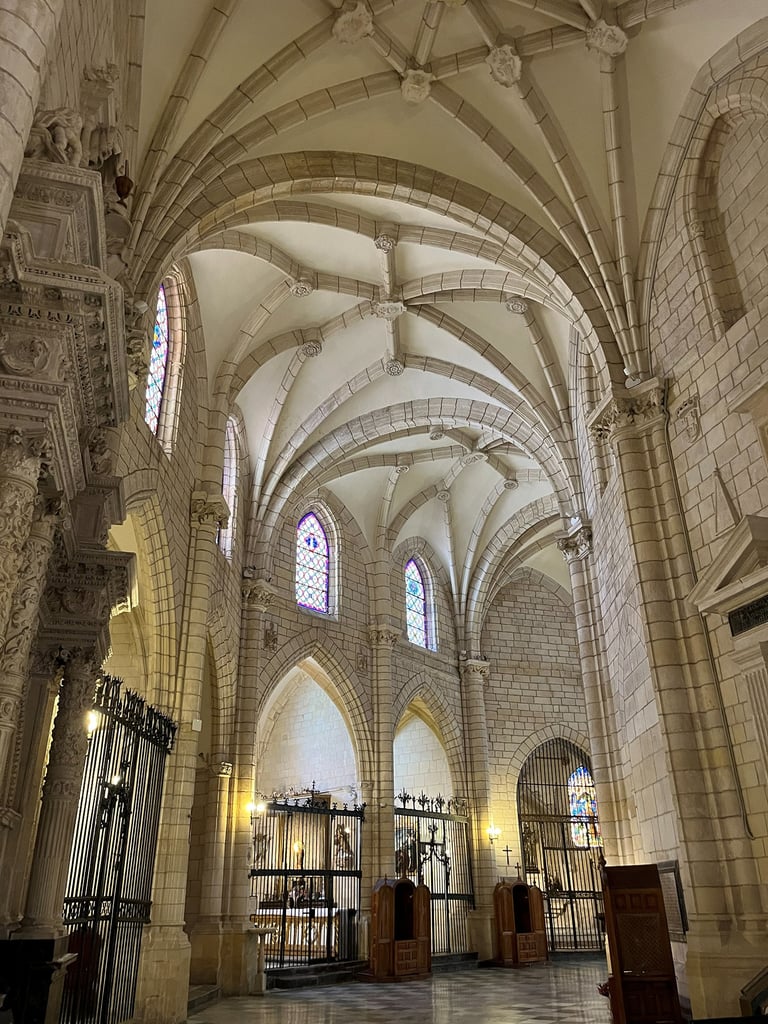
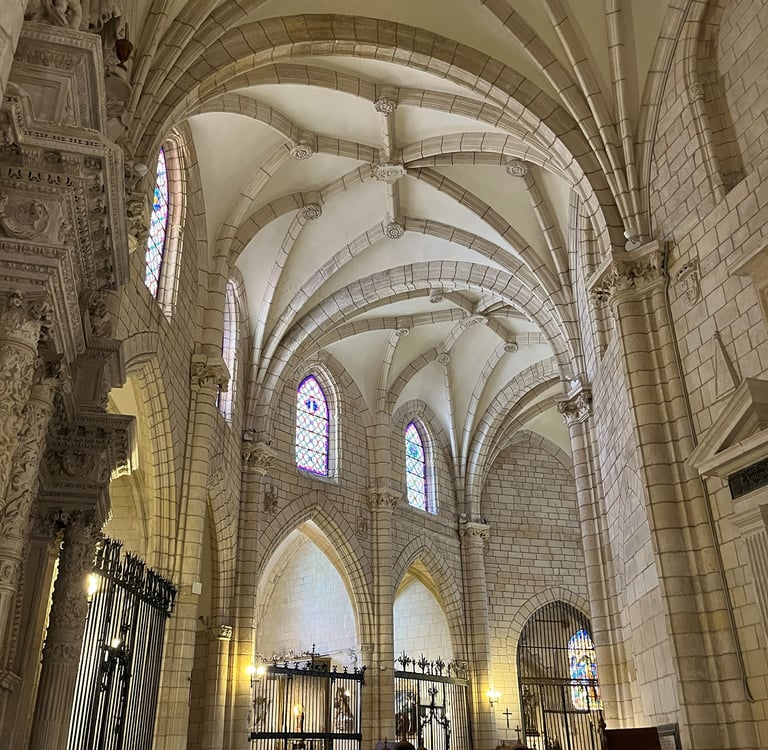
The interior retains the original Gothic structure built between the 14th and 15th centuries. The three naves rise through clustered pillars with attached columns and vegetal capitals on which ribbed vaults rest.
The central nave conveys a notable sense of spaciousness, although the presence of the monumental choir interrupts the typical longitudinal perspective found in other Gothic cathedrals.
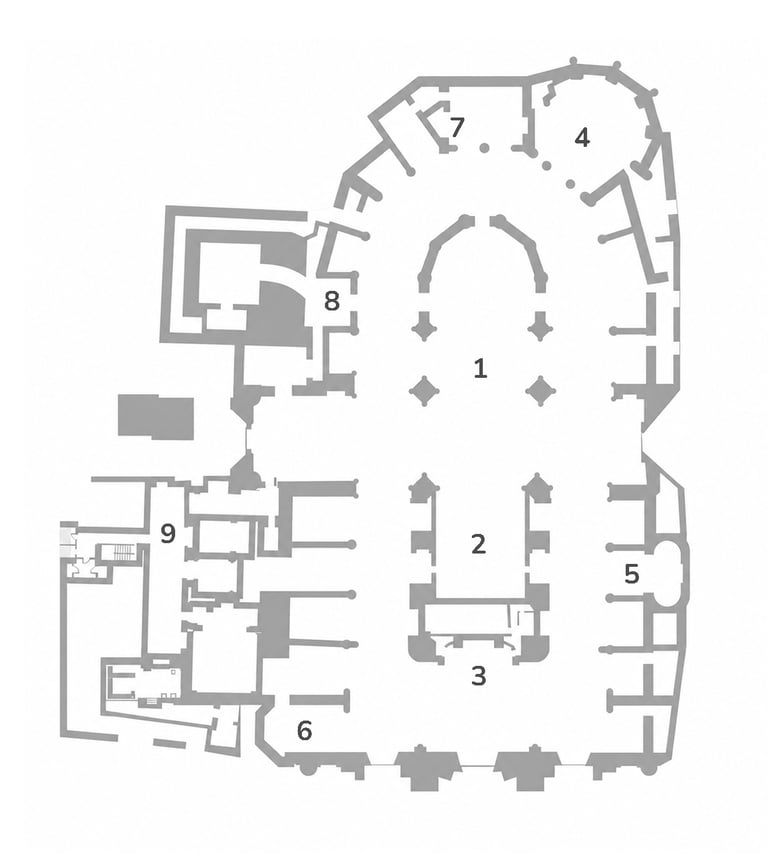
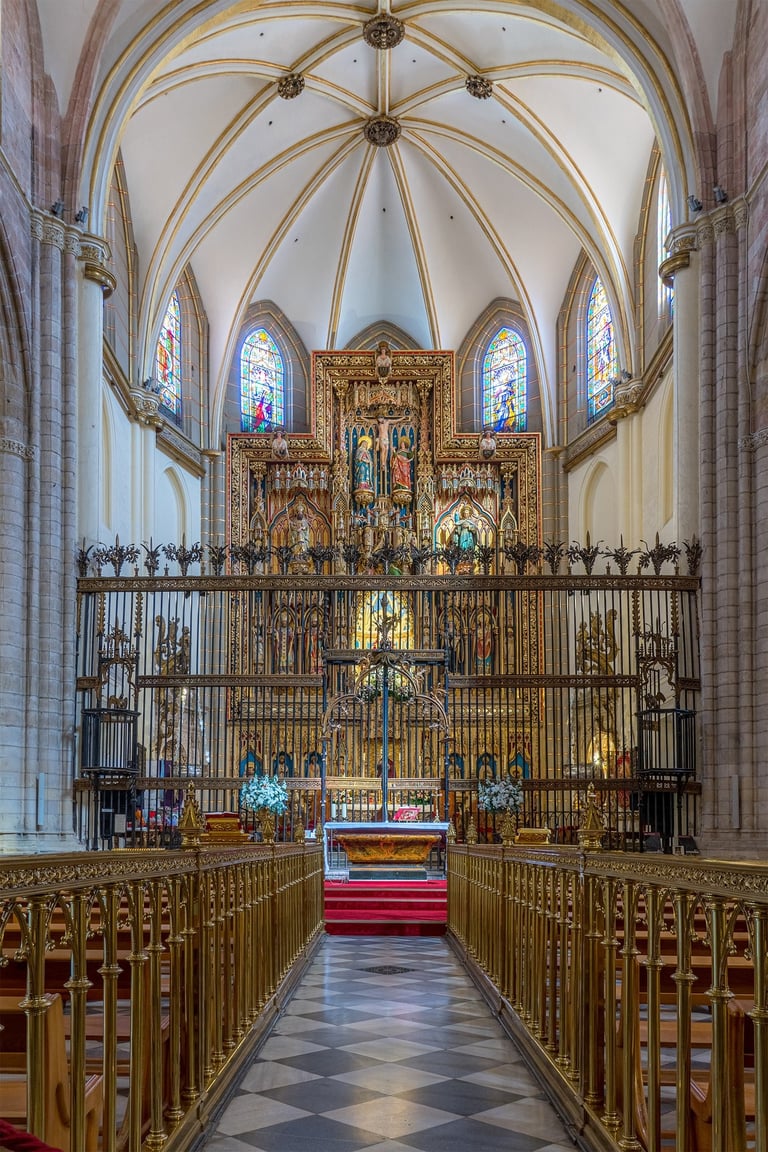
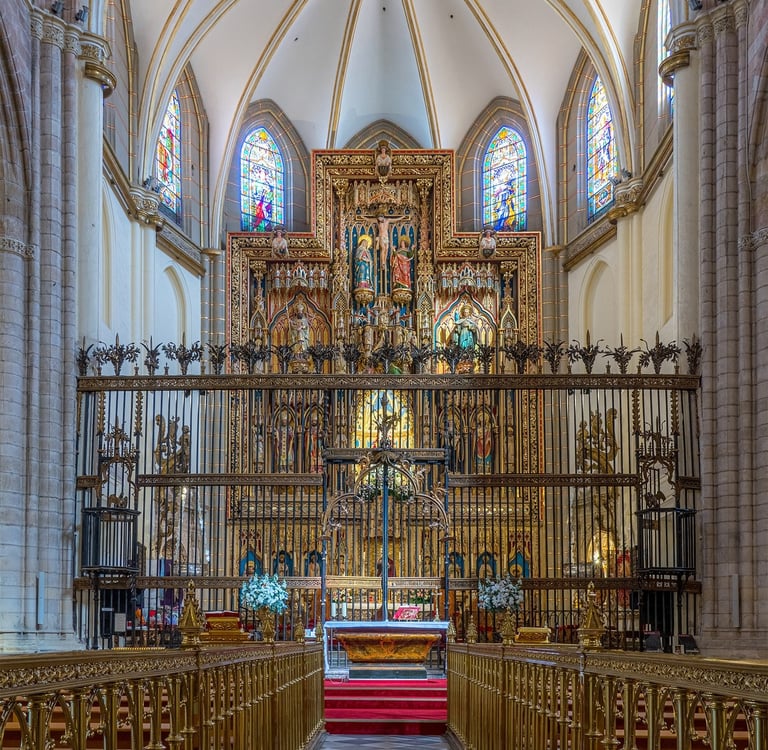
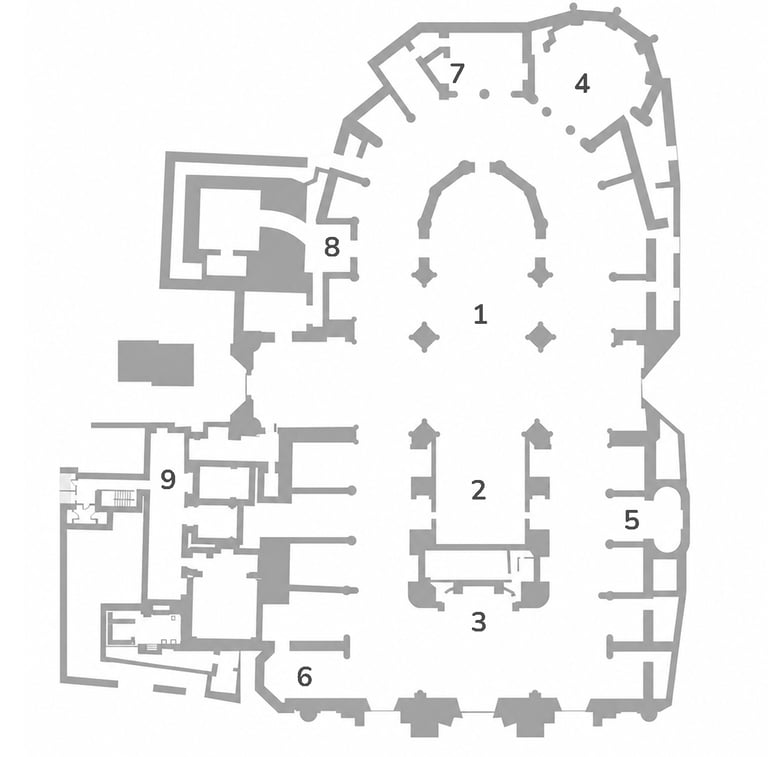
The Main Chapel (1)
The Main Chapel constitutes the liturgical nucleus of the cathedral. The current neo-Gothic altarpiece was designed by Mariano Pescador after the fire of 1854 that destroyed the ancient Renaissance altarpiece.
The ensemble is presided over by the Virgin of Peace and surrounded by sculptures of saints linked to the Cartagena diocese.
On the Gospel side, the sepulchral urn containing the heart and entrails of Alfonso X the Wise is preserved, a great promoter of the incorporation of the Kingdom of Murcia into Castile.
In front of it, the relics of Saint Fulgentius and Saint Florentina are venerated, two of the four brothers known as the Saints of Cartagena, along with Saint Leander and Saint Isidore.
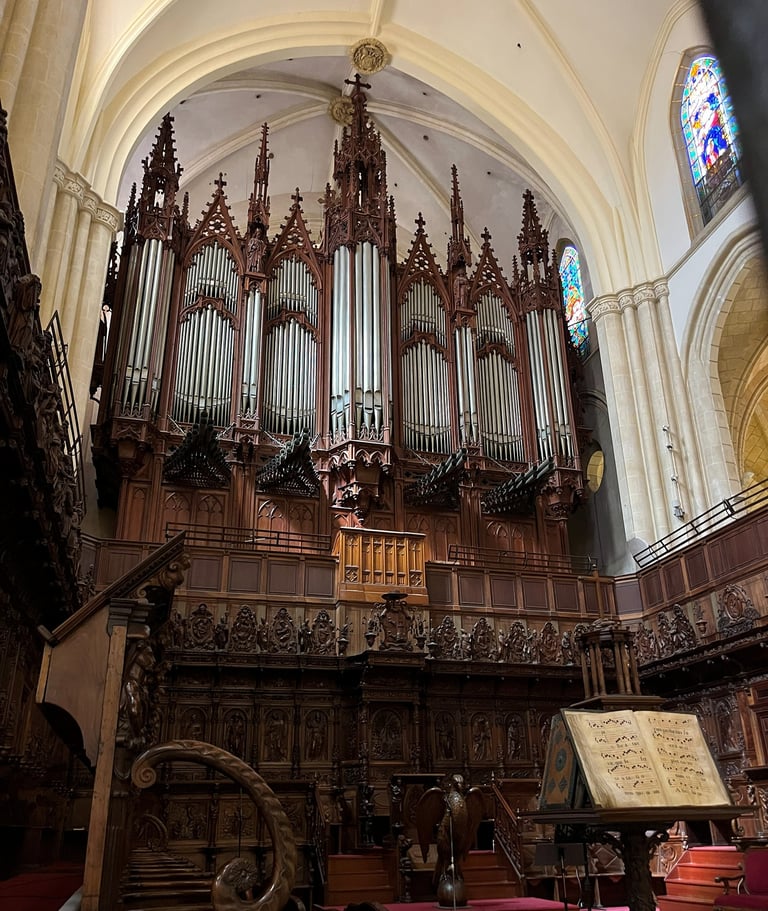
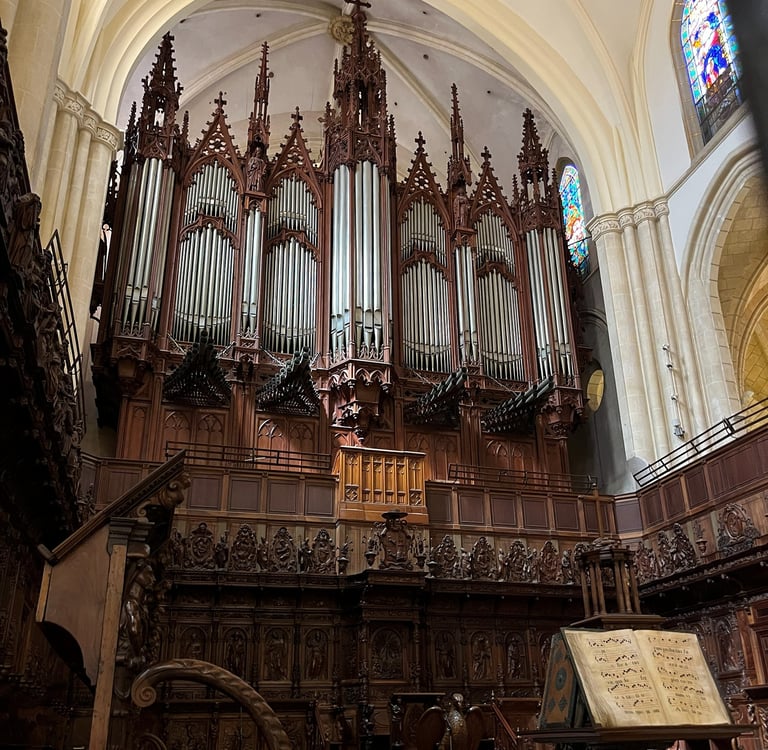
The choir and the organ (2)
The cathedral choir is one of the most spectacular spaces in the interior. The current choir stalls come from the monastery of San Martín de Valdeiglesias and were gifted by Isabel II after the fire of 1854.
Designed by Rafael de León in the 16th century, it is one of the best preserved plateresque choir stalls in Spain. The carving features scenes from the Old Testament, saints, prophets, masks, and complex ornamental compositions.
Above the choir rises the great neogothic organ built by the German organ maker Joseph Merklin, regarded at the time as one of the largest in the world.
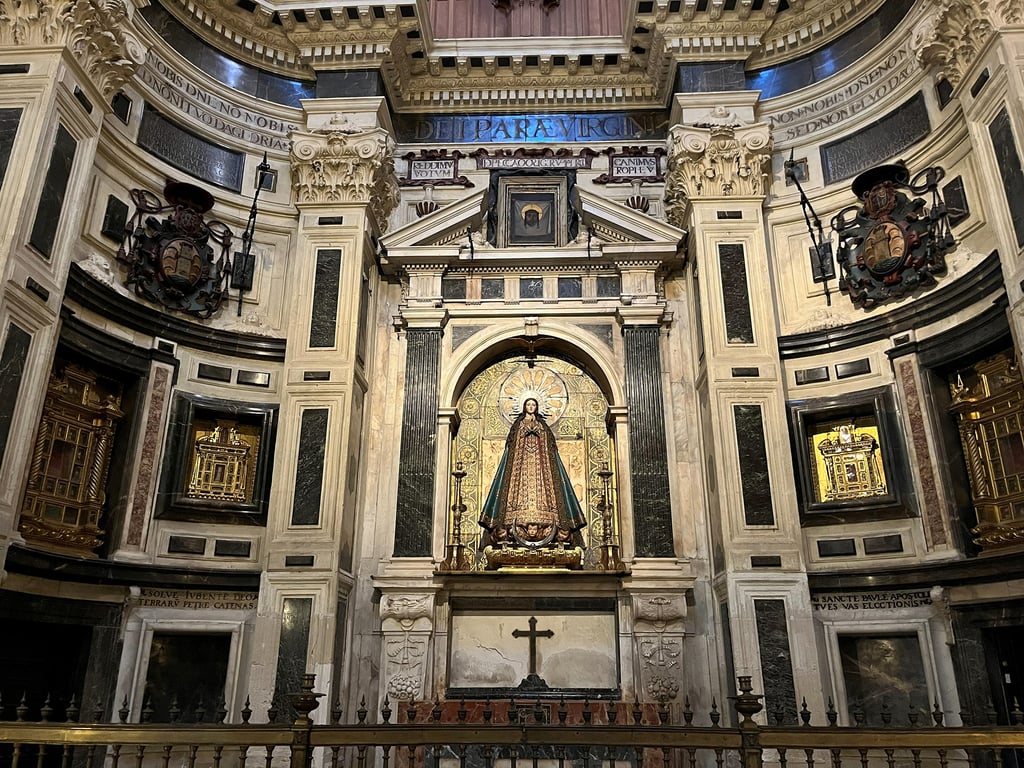
The Trascoro and the Chapel of the Immaculate (3)
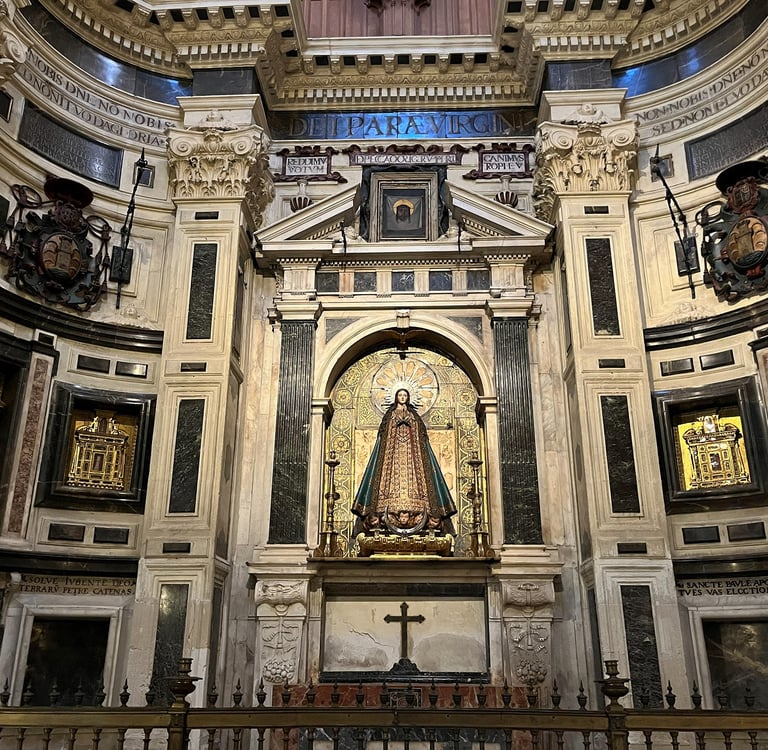
The trascoro (back of the choir) houses one of the most original baroque works of the temple: the Chapel of the Immaculate, promoted by Bishop Trejo between 1620 and 1628. It is the first cathedral chapel dedicated to the Immaculate Conception of Mary in Spain.
It is one of the first Spanish cathedral chapels specifically dedicated to the mystery of the Immaculate Conception. The combination of polychrome marbles, the Italianate style, and the decorative richness creates a space that is completely different from the rest of the cathedral.
The great chapels of the Cathedral
The ambulatory and the side naves host numerous funerary and devotional chapels built between the 15th and 18th centuries. Here you can practically follow the entire artistic evolution of Murcia from the late Gothic to Neoclassicism. We include here the most remarkable chapels from an artistic point of view, all of them analyzed in detail in our guided tour of the Cathedral of Murcia:
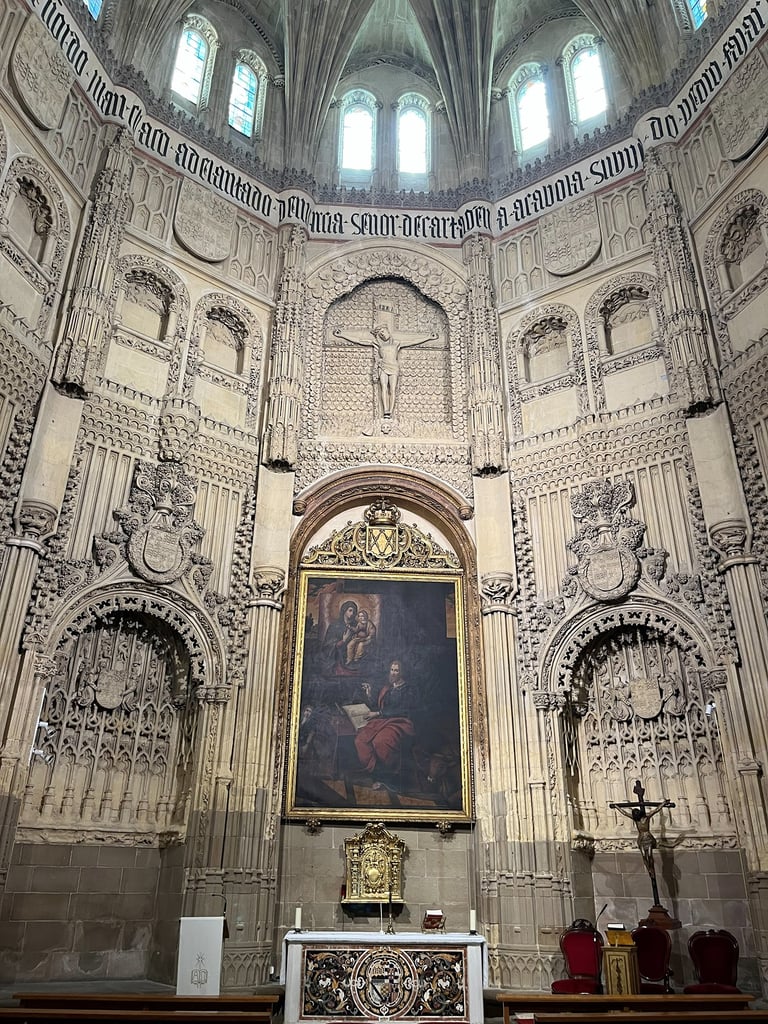
The Chapel of the Vélez (4)
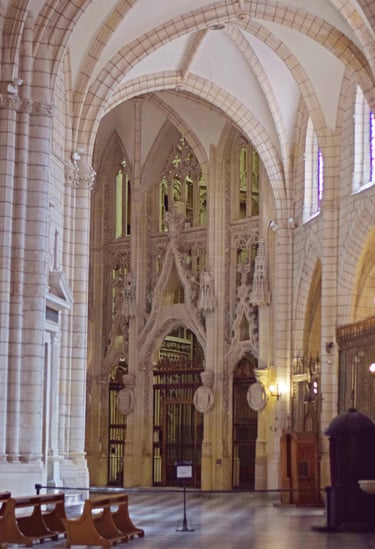
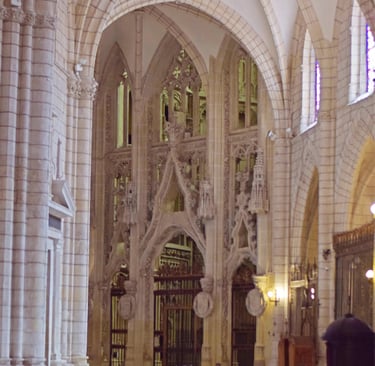
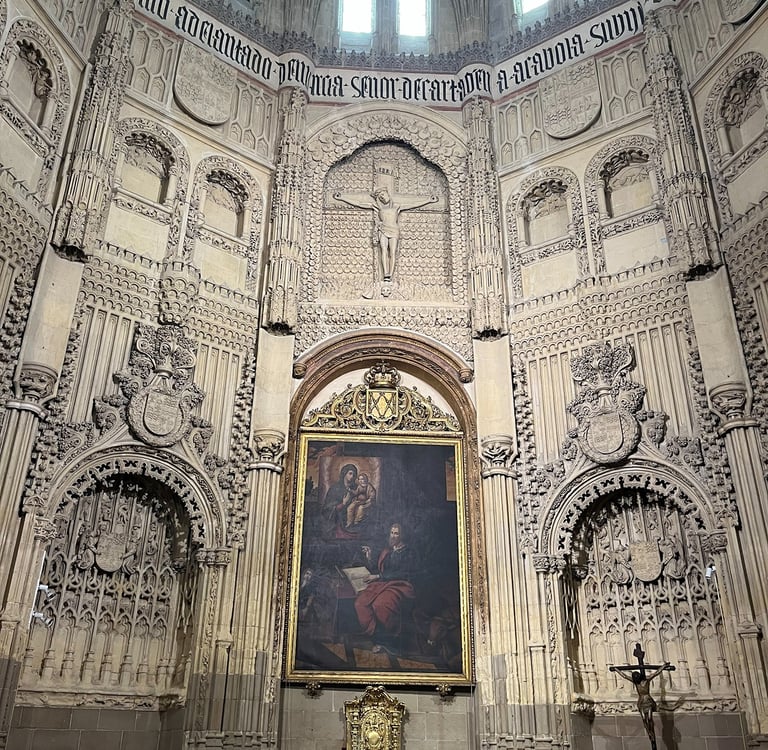
The Chapel of the Vélez is the most spectacular work of late Gothic Murcia and one of the most fascinating spaces of Spanish art at the beginning of the 16th century.
It was initiated in 1490 by Juan Chacón and completed in 1507 by his son Pedro Fajardo, the first Marquis of the Vélez.
The chapel mixes Gothic, flamboyant, Mudejar, and Renaissance elements with extraordinary decorative exuberance. The decagonal starry vault, the heraldic shields, the exterior stone chains, and the highly complex sculptural decoration turn the space into a true work of goldsmithing in stone.
The Chapel of Junterón (5)
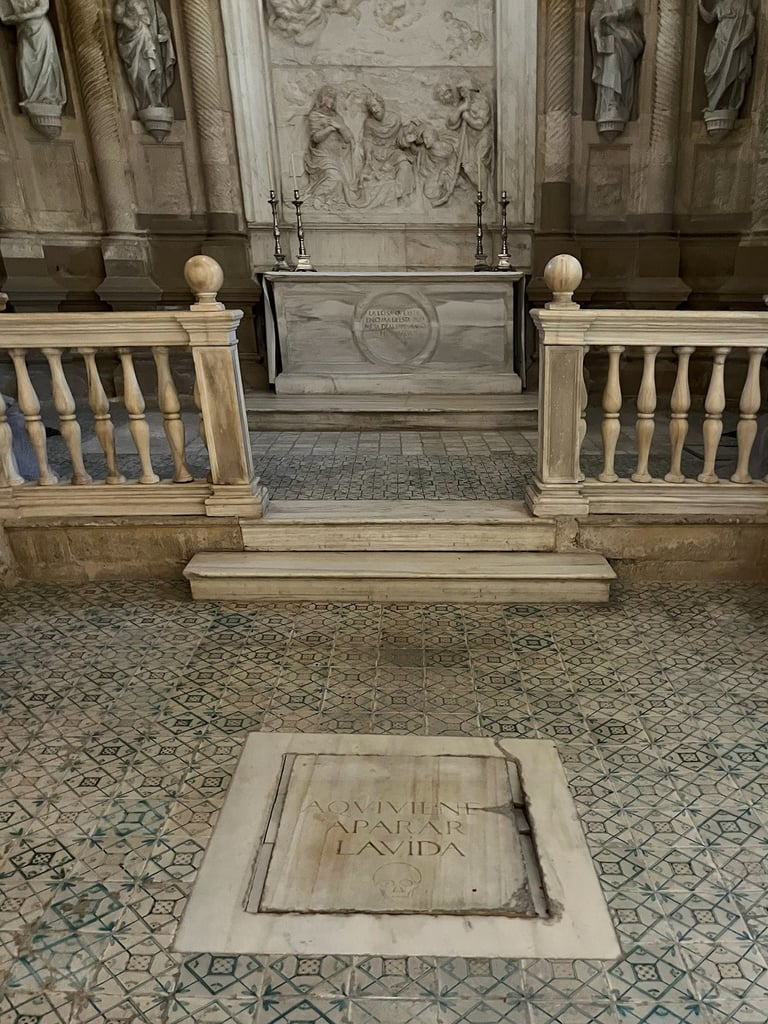
The Chapel of Junterón is one of the peaks of the Spanish Renaissance. It was promoted by Gil Rodríguez de Junterón, apostolic protonotary and high pontifical official linked to Rome.
Jerónimo Quijano designed a space of enormous architectural sophistication where the elliptical plan, plateresque decoration, and above all, the spectacular semicircular vault filled with grotesques, mask heads, fantastic figures, and Italianate motifs stand out.
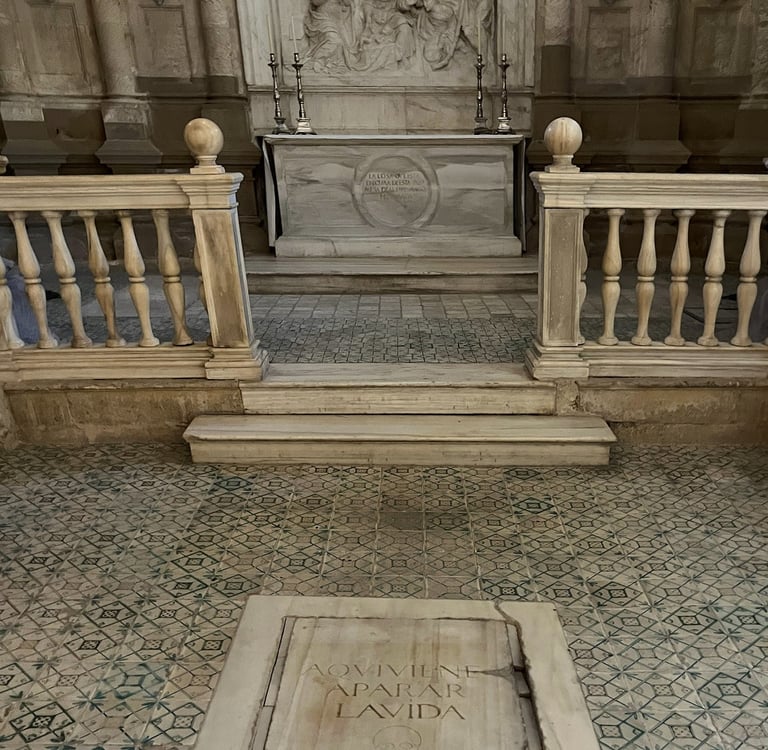
On the pavement appears a deeply humanist funerary inscription: “Here comes the end of life.” It is worth remembering that the promoter of this chapel is buried in the crypt that lies beneath it.
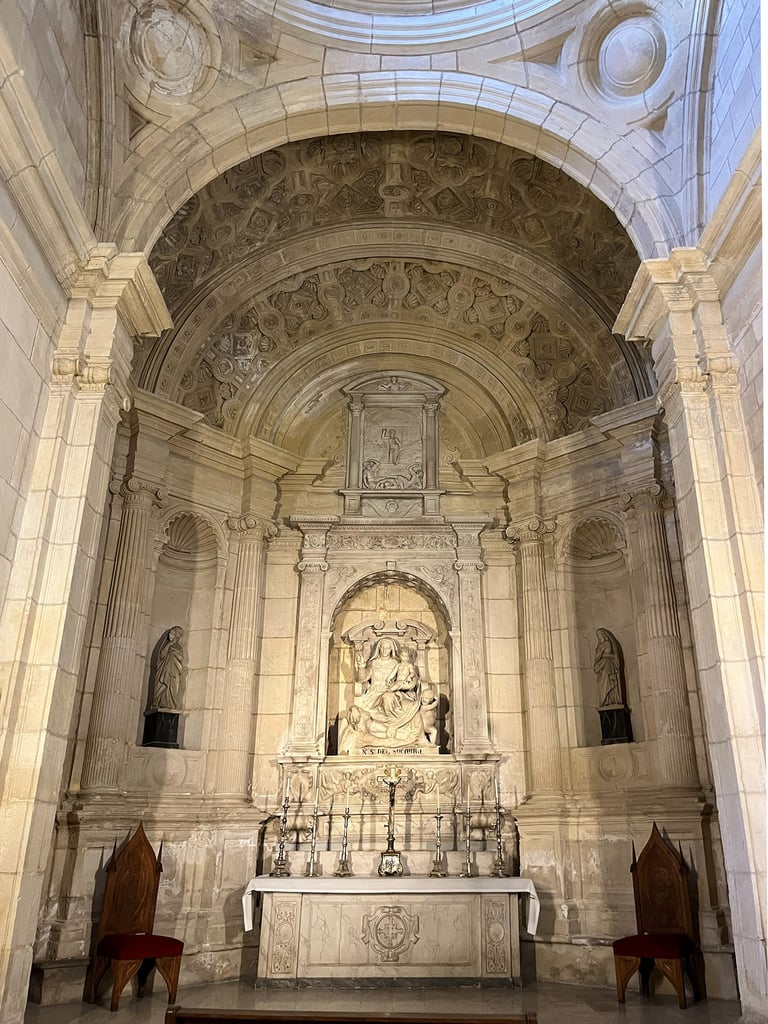
The Chapel of the Socorro (6)
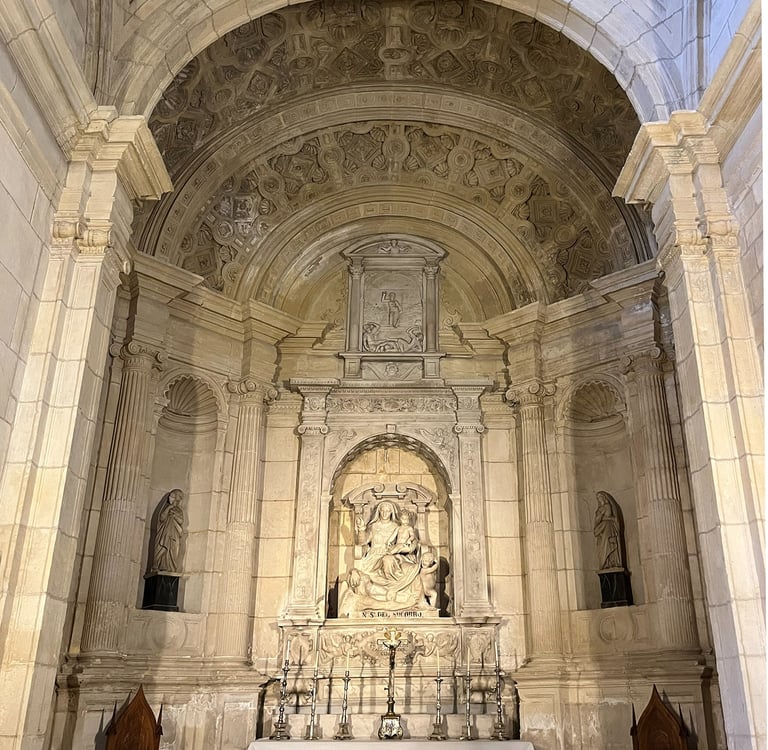
The ancient chapel of the Baptistery or of Socorro was founded in the 16th century by Jerónimo Grasso. It is considered one of the most refined Renaissance works of the temple.
The stone vault, the Italian baptismal font, and the magnificent marble altarpiece dedicated to the Virgin of Socorro stand out.
The Chapel of the Incarnation (7)
Designed also by Jerónimo Quijano, the Chapel of the Incarnation constitutes a small gem of Murcian Plateresque style. Its triangular plan and the elaborate sculptural program showcase the architect's extraordinary technical mastery.
Furthermore, it preserves the tomb of Jacobo de las Leyes, a jurist linked to Alfonso X and a collaborator in the drafting of the Siete Partidas.
The sacristy and its Renaissance facade (8)
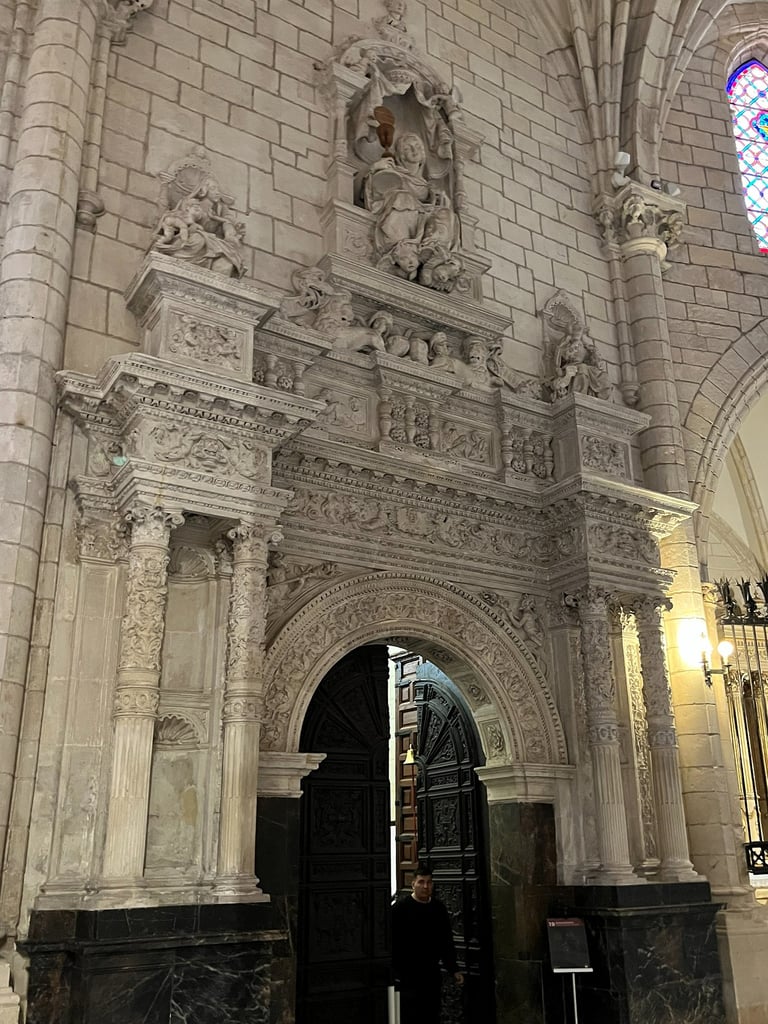
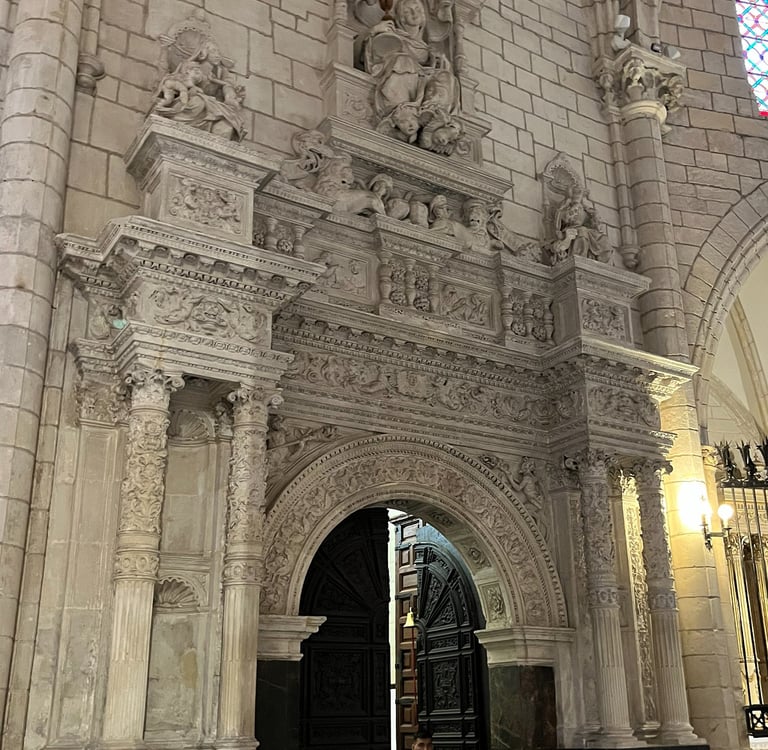
The facade of the anteroom is one of the masterpieces of the Murcian Renaissance. Designed by Jerónimo Quijano in the 16th century, it features a composition inspired by classical triumphal arches and is decorated with paired columns, reliefs, and allegorical sculptures of the theological virtues.
The interior of the sacristy preserves one of the most important Renaissance decorations in Spain. The coffered vault, the walnut cabinetry, the sculptural reliefs, and the complex iconographic program reveal the direct influence of Italian art introduced by Jacobo Florentino and continued by Quijano.
The Cathedral Museum (9)
The current Cathedral Museum occupies the remains of the ancient Gothic cloister from the 14th century, one of the oldest preserved parts of the cathedral complex.
Although much of the cloister was destroyed in the 20th century with the construction of the current porticoes, the museum has allowed for the recovery and dignification of a good part of this historical space.
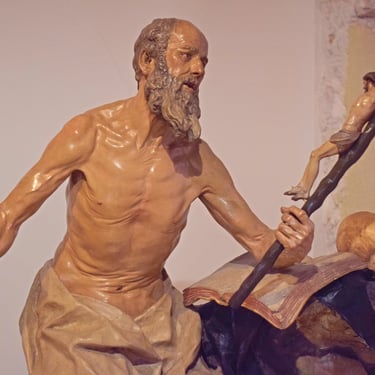
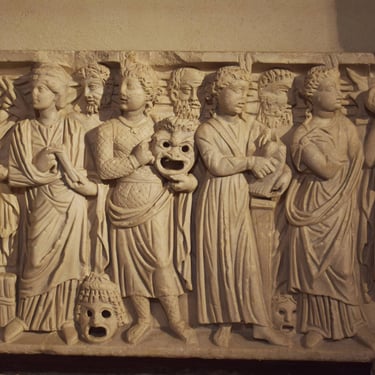
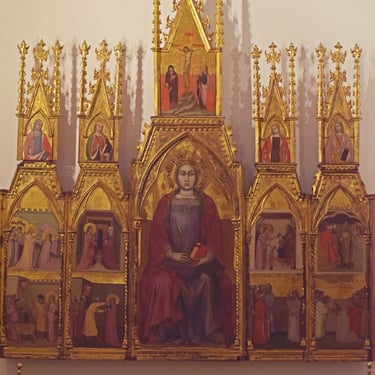
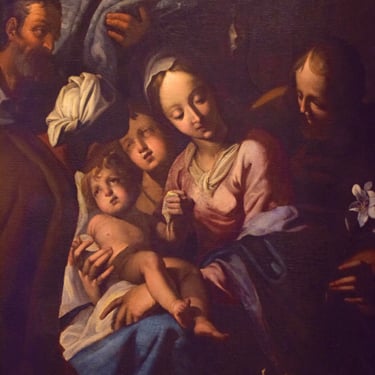
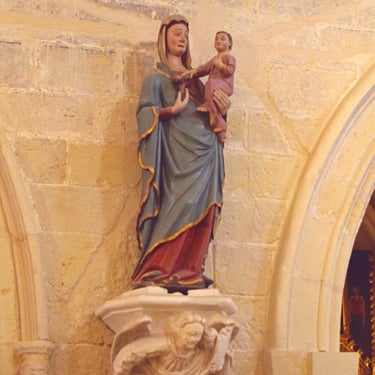
The collection brings together some of the most important works of Murcian artistic heritage: the Roman sarcophagus of the Muses, paintings by Bernabé de Módena, Hispano-Flemish panels, pieces of baroque goldsmithing, and sculptures by Francisco Salzillo, including the famous St. Jerome Penitent.
The museum visit also allows for an understanding of the complex historical evolution of the cathedral and discovering archaeological remains of the ancient Islamic mosque upon which the main Christian temple of Murcia was built.
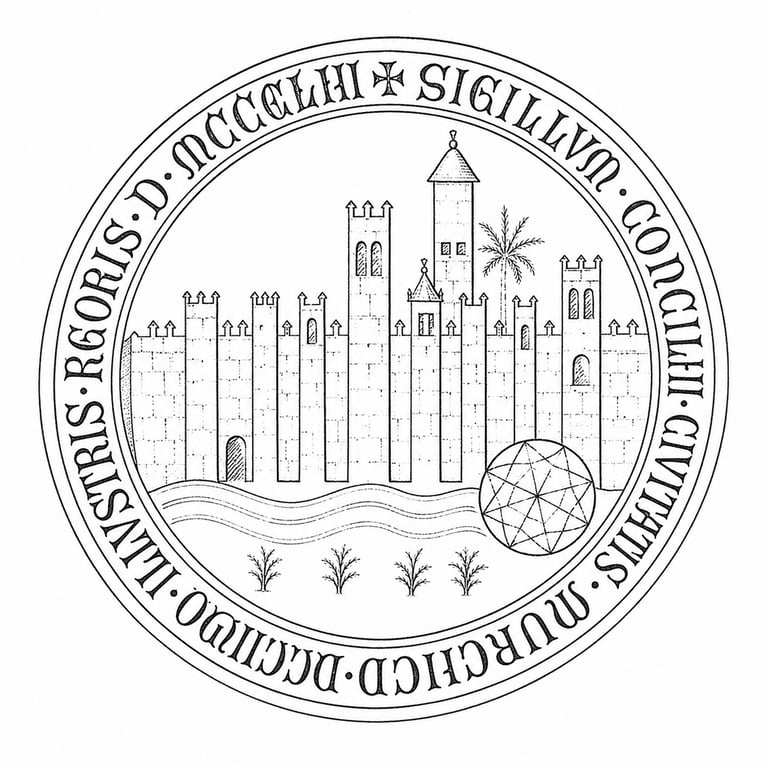
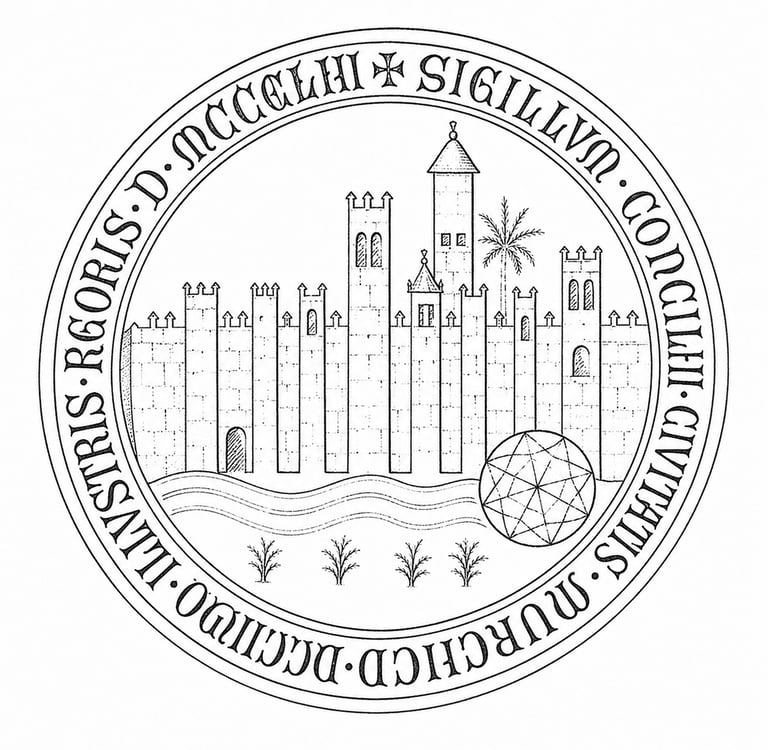
Reproduction of the seal of the Murcia City Council from 1374, featuring the earliest surviving depiction of a view of the city of Murcia. The tallest tower would have been the former minaret of the mosque, used as a bell tower during the Christian era.
Guided tour of the Cathedral of Murcia and its museum
After learning about the history and the main areas of the Cathedral of Murcia, nothing better than discovering them on-site. Our guided tour will allow you to explore the interior of the temple accompanied by a specialized guide, interpreting details that often go unnoticed and understanding the historical and artistic significance of one of the most important monuments in the Region of Murcia. A different way to get to know the cathedral and enjoy all its secrets.
Learn more about the guided tour of the Cathedral of Murcia...
Guided tour of the Cathedral of Murcia and its museum
Do you want to explore the Cathedral of Murcia in depth? Join us on a guided tour of its exterior and interior, and learn about the history, art, and curiosities of one of the city's most emblematic monuments. From the Chapel of the Vélez to the heart of Alfonso X, we will help you interpret every corner of this extraordinary temple. The tour lasts for 2 hours and is led by an official tour guide, graduated in history and a specialist in historical heritage.
Learn more about the guided tour of the Cathedral of Murcia...
📷 Fernando
CATHEDRAL OF MURCIA
The Cathedral of Santa María of Murcia is the main temple of the city and, probably, the most recognizable monument of the entire Region of Murcia. Furthermore, it is a work built over more than four centuries, a building where the political, religious, and artistic history of the ancient Kingdom of Murcia has been written in stone. Its current image is the result of a slow layering of styles, masters, and projects that transformed an ancient Islamic mosque into one of the most unique cathedrals in the Spanish Mediterranean.
Few Spanish cathedrals show so clearly the evolution of peninsula architecture between late Gothic and full Baroque. The Cathedral of Murcia still preserves the structural sobriety of Castilian Gothic, incorporates some of the most important Renaissance works from the Spanish 16th century, and culminates externally with one of the most spectacular Baroque façades in Europe.
Here we offer you some interesting facts about the history and artistic values of our cathedral, although the best option to truly get to know it is to book one of our guided tours of the Cathedral of Murcia. Always alongside an official guide, expert in history and artistic heritage.
The ancient Islamic Great Mosque
The origin of the temple dates back to the very heart of Andalusian Murcia. On the site where the cathedral now stands, the main religious building of the Islamic city, the Great Mosque, was erected in the 9th century by Abd al-Rahman II.
After the Castilian conquest of the Kingdom of Murcia in the 13th century, the mosque was consecrated to Christian worship under the invocation of Santa María. For decades, as happened in many peninsular cities, the ancient Muslim building continued to be partially used while being adapted to Christian liturgical needs.
Even today, beneath the cathedral museum and some attached dependencies, archaeological remains of that Great Mosque are preserved. The walkway of the current Museum of the Cathedral allows visitors to contemplate part of these structures, turning the tour into an authentic journey to the historical origins of Murcia.
La capilla de Junterón, cuya construcción se inicia hacia 1515, es uno de los primeros espacios renacentistas en la historia del arte español.
The construction of the Christian cathedral
The first attempts to raise a large cathedral began in the 14th century. Bishop Pedro Peñaranda initiated a new church around 1320 after definitively demolishing the remains of the Islamic mosque, although that first project was never completed.
The definitive construction officially began on January 22, 1394, when Bishop Fernando de Pedrosa laid the first stone of the current building. Unlike other large Castilian cathedrals built in contexts of great economic prosperity, the Murcia cathedral advanced slowly and with limited resources. This circumstance partly explains the relative sobriety of its original Gothic structure.
The work was essentially completed in the 15th century. In 1462, the vaults of the temple were being closed, and a few years later, during the pontificate of Lope de Rivas, the cathedral was finally consecrated.
Architecturally, the Cathedral of Murcia belongs to the last Castilian Gothic, although it shows a notable influence from Mediterranean and Catalan Gothic. It has a Latin cross plan, three naves, a choir, and lateral chapels open between the buttresses. However, the exterior perception of the building was profoundly altered by the major reforms of the following centuries.
The Renaissance and the Monumental Transformation of the Cathedral
The 16th century marked one of the brightest moments in the artistic history of Murcia. The economic boom of the Kingdom and the strength of the chapter sparked a profound renewal of the cathedral, which went from being an essentially Gothic building to becoming a great laboratory of Spanish Renaissance.
During this period, some of the most important architects of the time worked, especially Jacobo Florentino, a pupil of Michelangelo, and Jerónimo Quijano, a key figure of the Murcian Renaissance.
They are responsible for many of the masterpieces of the temple: the first bodies of the tower, the facade of the Sacristy, the Chapel of Junterón, the Chapel of Baptism, and various interior reforms. The Renaissance introduced new spatial conceptions, Classicist decoration, Italianate repertoires, and a sculptural richness unknown until then in Murcia.
The result was an extraordinarily complex cathedral, where medieval Gothic began to coexist with Plateresque and Renaissance Classicism.
The monumental gates of the Cathedral
The Apostles' Gate: the great Gothic access
The Apostles' Gate (Puerta de los Apóstoles), located on the south facade, is the most important medieval access preserved in the cathedral. It began construction in 1463 and was completed in 1488 in Gothic style.
The facade features an elegant conopial arch decorated with archivolts and sculptures. On either side appear the images of Santiago, San Pedro, San Andrés, and San Pablo, which gave the door its name.
Above the ensemble stands the magnificent flamboyant rose window that illuminates the interior crossing. The shield of Isabel II, added later, recalls the financial assistance provided by the queen after the devastating fire of 1854.
This door is the meeting point for our cathedral tour of Murcia . Don’t hesitate to book it if you want to deeply understand the monumental heart of the city.
Puerta de las Cadenas: the triumph of Plateresque
The north façade houses the celebrated Puerta de las Cadenas (Gate of Chains), one of the first manifestations of Plateresque Renaissance in southeastern Spain.
Its lower body, built in the early 16th century and attributed to Juan de León, features a monumental semicircular arch decorated with medallions, classical busts, cherubs, and vegetal motifs.
The iconographic program exalts the conquest of Granada by the Catholic Monarchs and the religious unity of the Hispanic monarchy. In the spandrels appear Saint Peter and Saint Paul, while the upper body incorporates images of the Carthaginian saints and a representation of the Virgin.
The name of the door comes from the chains that surround the cross located in front of the entrance.
The Baroque Front: The Great Facade of Jaime Bort
The main facade of the Cathedral of Murcia constitutes one of the culminating works of Spanish Baroque from the 18th century.
The old Renaissance portal suffered severe structural problems due to earthquakes, floods, and foundation deficiencies. It was finally demolished in 1732 and replaced by the monumental front designed by Jaime Bort, with technical intervention by the engineer Sebastián Feringán.
Constructed between 1737 and 1754, the facade was conceived as a gigantic stone altarpiece dedicated to the Virgin Mary and the glories of the diocese of Cartagena.
The sculpture here ceases to be a mere architectural complement to become the absolute protagonist. Saints, apostles, archangels, bishops, and kings form a complex theatrical scenery where the Assumption and Coronation of the Virgin stand out.
The dynamism of the lines, the play of light and shadow, the indentations and projections, the enormous columns, and the ornamental exuberance turn this facade into one of the peaks of Mediterranean Baroque Europe.
Its relevance within the history of Spanish Baroque is enormous: it practically represents the last great Baroque front raised in Spain and one of the most brilliant syntheses between architecture and monumental sculpture.
The Tower of the Cathedral of Murcia
The bell tower constitutes the great vertical symbol of Murcia and one of the most important bell towers in Spain. At 93 meters tall, 95 with the weather vane, it was for centuries the tallest building in the entire Region.
Construction began in 1519 and was not completed until 1793, a circumstance that explains the extraordinary mix of styles presented.
The first section corresponds to Jacobo Florentino and represents one of the earliest examples of Spanish Renaissance. The second section was created by Jerónimo Quijano and maintains the plateresque refinement of the whole.
After a long delay caused by foundation problems, work resumed in the 18th century. The third baroque section incorporates the cathedral clock; the fourth contains the famous conjuring spaces from which the fields were blessed and storms were conjured; and the fifth section adopts a language close to French rococo.
The final top was designed by Ventura Rodríguez in neoclassical style and executed under the direction of Pedro Gilabert.
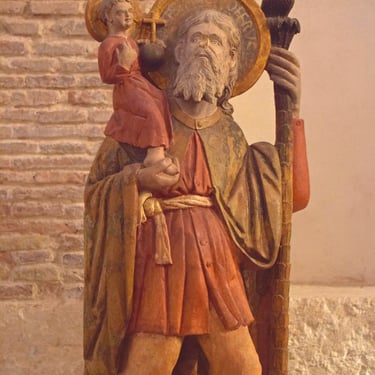
The bell tower currently has around twenty bells, each with its own name. Most were made in the 18th and 19th centuries. The museum of the cathedral preserves the one known as "Mora". It comes from the medieval tower preceding the current bell tower and has been dated to the 14th century, making it one of the oldest preserved bells in Spain.
The interior of the Cathedral of Murcia
The interior preserves the original Gothic structure built between the 14th and 15th centuries. The three naves rise on clustered pillars with attached columns and vegetal capitals on which ribbed vaults rest.
The central nave conveys a notable sense of spaciousness, although the presence of the monumental choir interrupts the typical longitudinal perspective of other Gothic cathedrals.
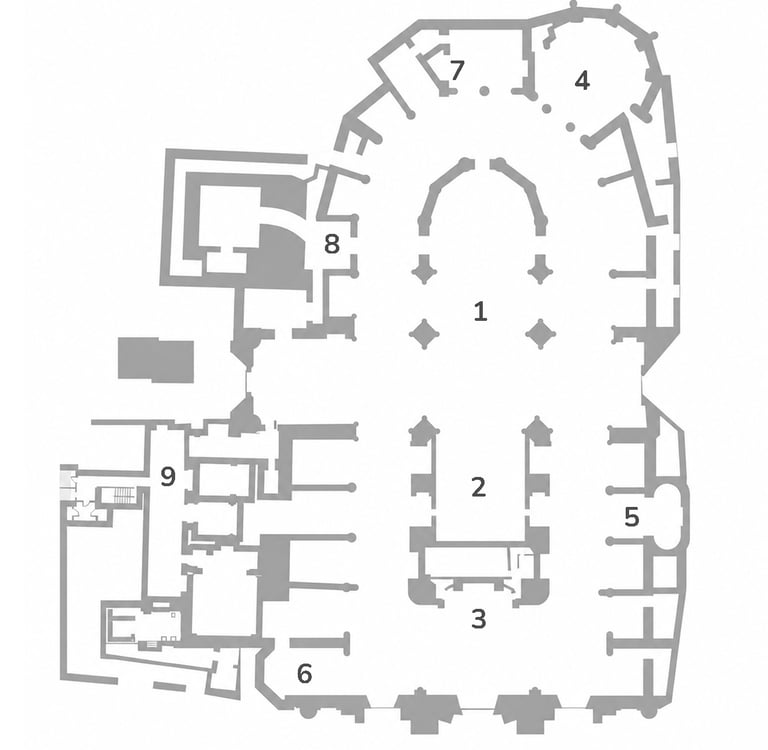
The Main Chapel (1)
The Main Chapel constitutes the liturgical nucleus of the cathedral. The current neo-Gothic altarpiece was designed by Mariano Pescador after the fire of 1854 that destroyed the old Renaissance altarpiece.
The ensemble is presided over by the Virgin of Peace and surrounded by sculptures of saints linked to the Cartagena diocese.
On the side of the Gospel, the sepulchral urn containing the heart and entrails of Alfonso X the Wise is preserved, a great promoter of the incorporation of the Kingdom of Murcia into Castile.
In front of it are venerated the relics of Saint Fulgentius and Saint Florentina, two of the four brothers known as the Saints of Cartagena, along with Saint Leander and Saint Isidore.
The choir and the organ (2)
The cathedral choir is one of the most spectacular spaces in the interior. The current choir stalls come from the monastery of San Martín de Valdeiglesias and were gifted by Isabel II after the fire of 1854.
Made by Rafael de León in the 16th century, it is one of the best-preserved silver altarpieces in Spain. The carving depicts scenes from the Old Testament, saints, prophets, grotesques, and complex ornamental compositions.
Above the choir rises the grand neogothic organ built by the German organ builder Joseph Merklin, considered at the time one of the largest in the world.
The Trascoro and the Chapel of the Immaculate (3)
The trascoro (back of the choir) houses one of the most original Baroque works of the temple: the Chapel of the Immaculate, promoted by Bishop Trejo between 1620 and 1628. It is the first cathedral chapel dedicated to the Immaculate Conception of Mary in Spain.
It is one of the first Spanish cathedral chapels expressly dedicated to the mystery of the Immaculate Conception. The combination of polychrome marbles, Italianate taste, and decorative richness makes it a space completely different from the rest of the cathedral.
The great chapels of the Cathedral
The ambulatory and the side aisles house numerous funerary and devotional chapels built between the 15th and 18th centuries. In them, one can practically trace the entire artistic evolution of Murcia from late Gothic to Neoclassicism. Here we include the most outstanding chapels from an artistic point of view, all of which are analyzed in detail in our guided visit to the Cathedral of Murcia:
The Chapel of los Vélez (4)
The Chapel of los Vélez is the most spectacular work of late Gothic in Murcia and one of the most fascinating spaces in Spanish art from the early 16th century.
It was initiated in 1490 by Juan Chacón and completed in 1507 by his son Pedro Fajardo, the first Marquis of los Vélez.
The chapel mixes Gothic, Flamboyant, Mudejar, and Renaissance elements with extraordinary decorative exuberance. The decagonal starry vault, heraldic shields, exterior stone chains, and the exceptionally complex sculptural decoration turn the space into a true work of goldsmithing in stone.
The Chapel of Junterón (5)
The Chapel of Junterón is one of the peaks of the Spanish Renaissance. It was promoted by Gil Rodríguez de Junterón, apostolic protonotary and high-ranking papal official linked to Rome.
Jerónimo Quijano designed a space of enormous architectural sophistication where the elliptical plan, the Plateresque decoration, and especially the spectacular semicircular vault filled with grotesques, mask heads, fantastic figures and Italianate motifs stand out.
On the pavement, there is a profoundly humanist funerary inscription: "Here comes the end of life". It is worth remembering that the promoter of this chapel is buried in the crypt located beneath it.
The Chapel of Socorro (6)
The old chapel of the Baptistery or Socorro was founded in the 16th century by Jerónimo Grasso. It is considered one of the most refined Renaissance works of the temple.
The stone vault, the Italian baptismal font, and the magnificent marble altarpiece dedicated to the Virgin of Socorro stand out.
The Chapel of the Incarnation (7)
Also designed by Jerónimo Quijano, the Chapel of the Incarnation is a small jewel of the Murcian Plateresque style. Its triangular plan and elaborate sculptural program demonstrate the architect's extraordinary technical mastery.
Inside, it also houses the tomb of Jacobo de las Leyes, a jurist linked to Alfonso X and a collaborator in the drafting of the Siete Partidas.
The sacristy and its Renaissance façade (8)
The façade of the antechapel is one of the masterpieces of Murcian Renaissance. Designed by Jerónimo Quijano in the 16th century, it features a composition inspired by classical triumphal arches and is decorated with paired columns, reliefs, and allegorical sculptures of the theological virtues.
The interior of the sacristy preserves one of the most important Renaissance decorations in Spain. The coffered ceiling, the walnut cabinetry, the sculptural reliefs, and the complex iconographic program reveal the direct influence of Italian art introduced by Jacobo Florentino and continued by Quijano.
The Cathedral Museum (9)
The current Cathedral Museum occupies the remains of the ancient Gothic cloister of the 14th century, one of the oldest preserved parts of the cathedral complex.
Although much of the cloister was destroyed in the 20th century with the construction of the current porticos, the museum has allowed the recovery and dignification of a good part of this historical space.
The collection brings together some of the most important works of Murcian artistic heritage: the Roman sarcophagus of the Muses, paintings by Bernabé de Módena, Hispano-Flemish panels, pieces of Baroque goldsmithing, and sculptures by Francisco Salzillo, among them the famous San Jerónimo Penitente.
A visit to the museum also allows one to understand the complex historical evolution of the cathedral and discover archaeological remains of the ancient Islamic mosque on which the main Christian temple of Murcia was built.
Reproduction of the seal of the Council of Murcia from 1374 with the first recreation of a view of the city of Murcia that has been preserved. The tallest tower would correspond to the ancient minaret of the mosque, used as a bell tower in the Christian era.
📷 Fernando
Guided tour of the Cathedral of Murcia and its museum
Do you want to discover the Cathedral of Murcia in depth? Join us on a guided tour of its exterior and interior and learn about the history, art, and curiosities of one of the city's most emblematic monuments. From the Chapel of the Vélez to the heart of Alfonso X, we will help you interpret every corner of this extraordinary temple. The tour lasts 2 hours and is guided by an official tour guide, graduated in history and specialized in historical heritage.
Learn more about the guided tour of the Cathedral of Murcia...
Guided tour of the Cathedral of Murcia and its museum
After learning about the history and the main spaces of the Cathedral of Murcia, there is nothing better than discovering them on the ground. Our guided tour will allow you to explore the interior of the temple accompanied by a specialized guide, interpreting details that often go unnoticed and understanding the historical and artistic significance of one of the most important monuments in the Region of Murcia. A different way to get to know the cathedral and enjoy all its secrets.
Learn more about the guided tour of the Cathedral of Murcia...


