
City Hall of Murcia
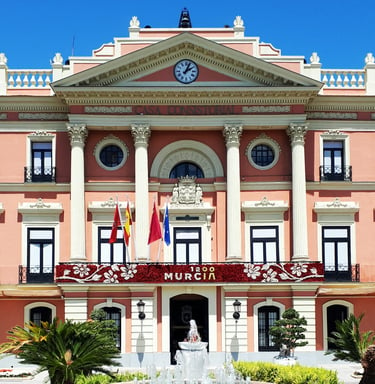
The main seat of the Murcia town hall is located in the Glorieta de España, an urban space that acts as a prelude to the historic center. Its position is not casual: since the Middle Ages this place has been linked to municipal power, configuring itself as one of the symbolic and administrative centers of the city.
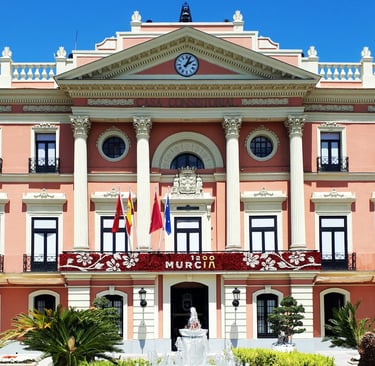
The current building is the result of a major renovation carried out in the mid-19th century, completed in 1848 under the direction of architect Juan José Belmonte. It fully responds to the neoclassical ideology, both in its composition and in its formal language: balance, symmetry, and a clear inspiration in classical architecture reinterpreted from the institutional values of the moment.
History
The history of the Town Hall of Murcia dates back much further than its current appearance. The building stands on the site that occupied the Daraxarife or Palace of the Prince, integrated into the Alcázar Mayor during the Islamic period. After the Christian conquest, Alfonso X the Wise donated this space to the council in 1267, consolidating its function as the seat of local government.
Over the centuries, the property adapted to the needs of the council. In the 18th century, coinciding with the urban transformation that gave rise to the promenade of Arenal —the current Glorieta—, the building was remodeled to integrate into the new urban space.
However, the decisive transformation came in the 19th century, when Mayor Salvador Marín Baldo promoted the construction of a new town hall in line with the demands of the moment. Between 1846 and 1847, while work was underway, the town hall temporarily relocated to the convent of Santo Domingo. In 1848, the building we know today was inaugurated.
Subsequently, the property was subject to various interventions: in 1892 architect Pedro Cerdán made internal reforms, and in 1927 César Cort designed the new plenary hall. Already in the 20th century, the lack of space led to the construction of an annex building in the nearby Belluga square, designed by Rafael Moneo and inaugurated in 1998.
Description
The building features a regular plan and a clear volumetry, organized into three heights and topped by a superior balustrade. Its elevation responds to a perfectly symmetrical scheme, with a central axis that concentrates the main representative elements.
Exterior
The main facade constitutes the most recognizable element of the building. It highlights a large central body with four Corinthian columns supporting a triangular pediment, emphasizing the monumental character of the main entrance.
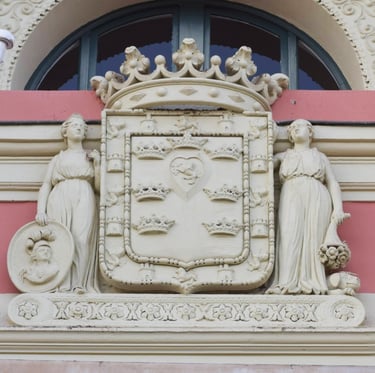
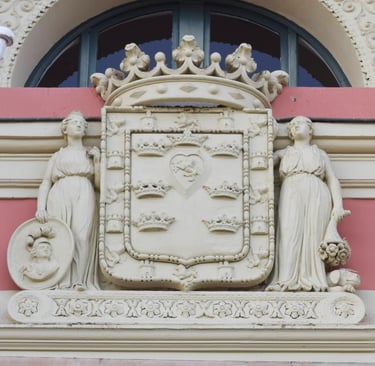
The central balcony, located above this porch, acts as a space for public representation. Above it, the city's coat of arms is positioned, flanked by two allegorical figures —Abundance and Happiness— which reinforce the symbolic discourse of the building.
In the pediment, the municipal clock is integrated, equipped with a carillon that plays characteristic melodies of Murcia, such as the city's anthem, adding a sonic component to the ensemble. The rest of the facade maintains a regular rhythm of openings and pilasters, with contained decoration that emphasizes the elegance of the whole.
Interior
The interior is organized around a monumental marble staircase with two flights that leads to the noble floor, the true institutional heart of the building. This space is enriched with stained glass made by the La Veneciana house in 1939, where the city's coat of arms figures.
The plenary hall, remodeled in 1927, constitutes the most solemn space. Its stained glass, created by the Maumejean house, depicts historical and devotional scenes linked to Murcia, such as the Cantigas of Alfonso X or the images of the Virgen de la Arrixaca and La Fuensanta.
Cultural visit
The building continues to serve administrative functions, so access to the interior is limited. However, institutional visits or public events are occasionally organized. For updated information, you can consult the City Hall website of Murcia.
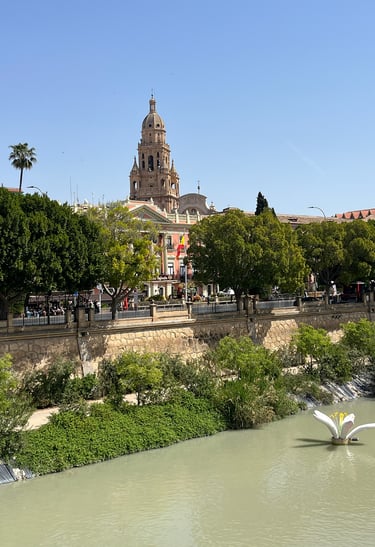
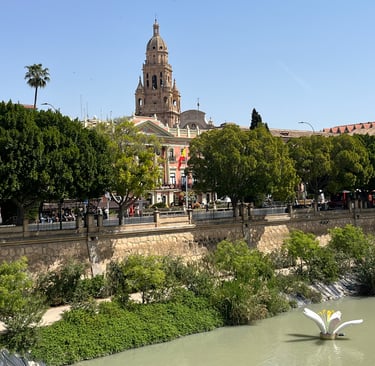
View of the Glorieta de España, with the town hall and cathedral in the background, from the other side of the Segura River.
The coat of arms of the city of Murcia decorates the main facade of the town hall. It is flanked by the allegorical figures of Happiness and Abundance.
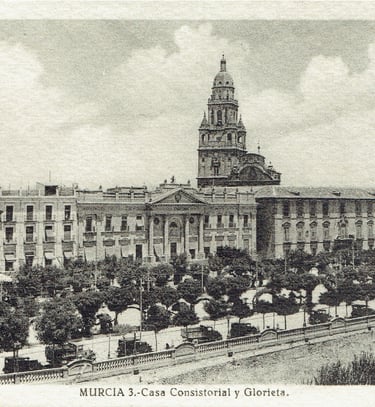
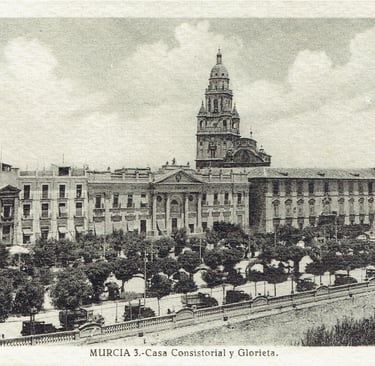
Image from the 1930s of the Glorieta, with the town hall and the cathedral in the background. Biblioteca digital de Murcia.


