
The imafronte of the cathedral of Murcia
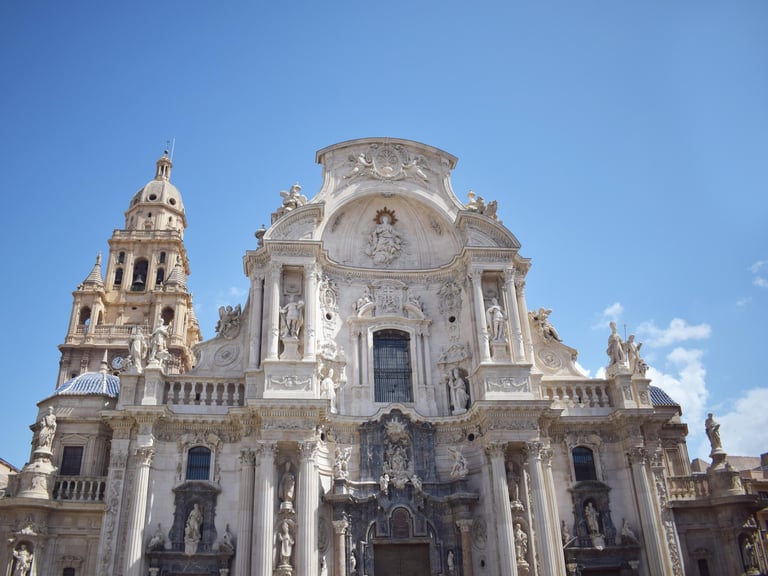
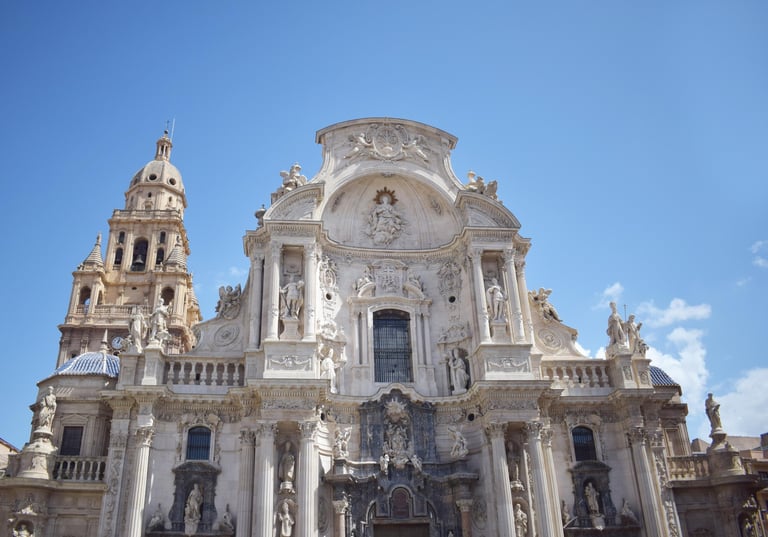
The splendid main facade of the cathedral of Murcia is in itself an expression of the apotheosis of baroque art, not only at the regional or national level but even at the European level. Generally known as "imafronte," an expression referring to the "facade that rises at the foot of a church or cathedral, opposite to the head."
The facade of the cathedral of Murcia presents a monumental baroque composition that was conceived not only as the main entrance to the temple but also as a grand visual proclamation of the identity of the diocese of Cartagena. Its extraordinary architectural and sculptural richness has made it one of the most recognizable creations of Spanish heritage and the most emblematic image of the city of Murcia, along with the tower of the same cathedral.
In this article, we will attempt to expose the most interesting aspects of this colossal work. But if you want to know in depth not only the imafronte but the entire cathedral complex, the best option is our guided tour of the cathedral of Murcia. A two-hour tour of the exterior and interior of the cathedral, including its museum, led by an official guide expert in history, architecture, and historical heritage. Do not hesitate to contact to book or request more information.
History of its construction
The current facade replaced an earlier one built in the 16th century under the direction of Jerónimo Quijano. At the beginning of the 18th century, that Renaissance facade presented serious structural problems caused by frequent earthquakes and the floods that periodically affected the city. After several technical reports, including those made by military engineer Sebastián Feringán, the cathedral chapter decided to adopt a radical solution: completely demolish the old western front and raise a new facade in line with the importance of the principal temple of the diocese.
The demolition began in 1732, although the construction of the new facade did not begin until 1737. The task fell to Jaime Bort, an architect and sculptor born in the old Kingdom of Valencia, whose artistic personality would decisively influence the final result. For over a decade, he personally oversaw the extraction of materials, the architectural design, the organization of the workshops, and the execution of the sculptures. Under his orders worked numerous stonemasons, sculptors, and artisans, including Vicente Bort, Manuel Bergaz, Jaime Campos, and Pedro Fernández. When Jaime Bort was called to Madrid in 1748, the direction passed to Pedro Fernández, who completed the work in 1754.
The preserved documentation indicates that the project conceived by Jaime Bort was even more ambitious than the facade ultimately executed. Various decisions made during the final phase of the works led to modifications of the originally planned design and to the suppression of one of the bodies contemplated in the original trace, although the disappearance of the project drawings prevents accurately reconstructing its definitive aspect.
A great stone altarpiece
The facade was conceived as a gigantic urban altarpiece facing the current plaza of Cardinal Belluga. Its function went far beyond the simple protection of access to the temple: it had to impress the visitor, convey the main messages of the Catholic faith, and exalt the history of the diocese.
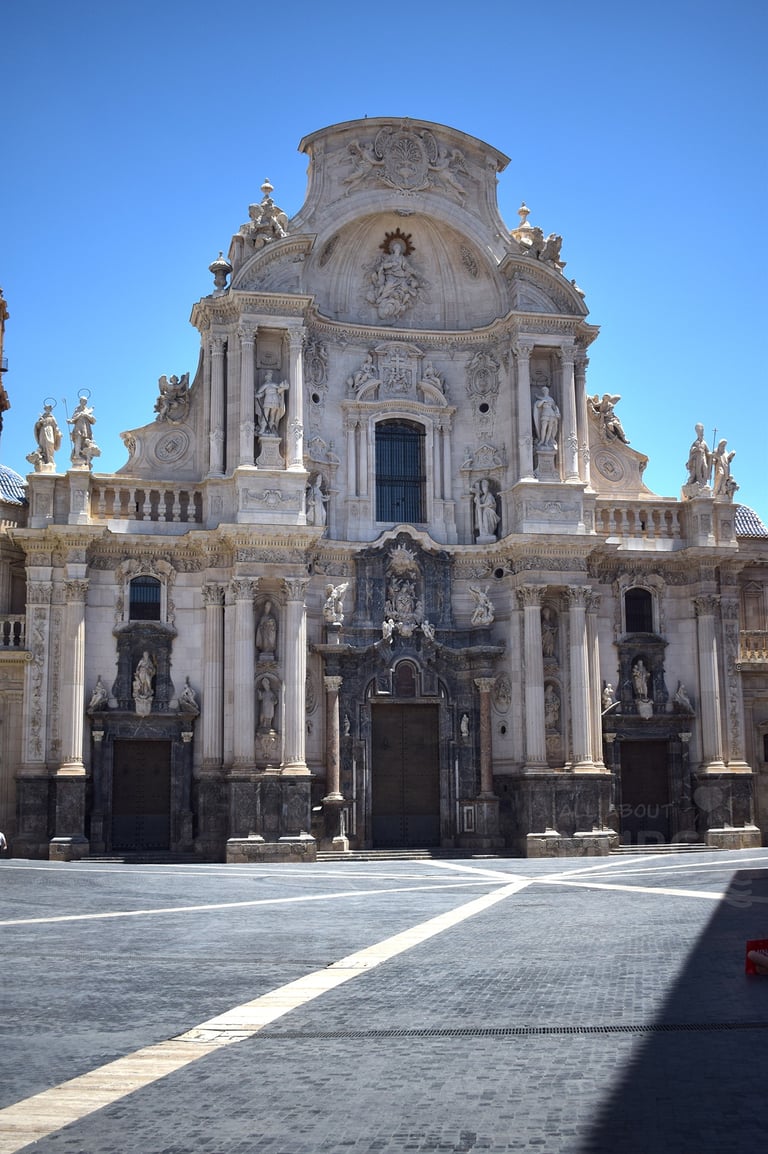
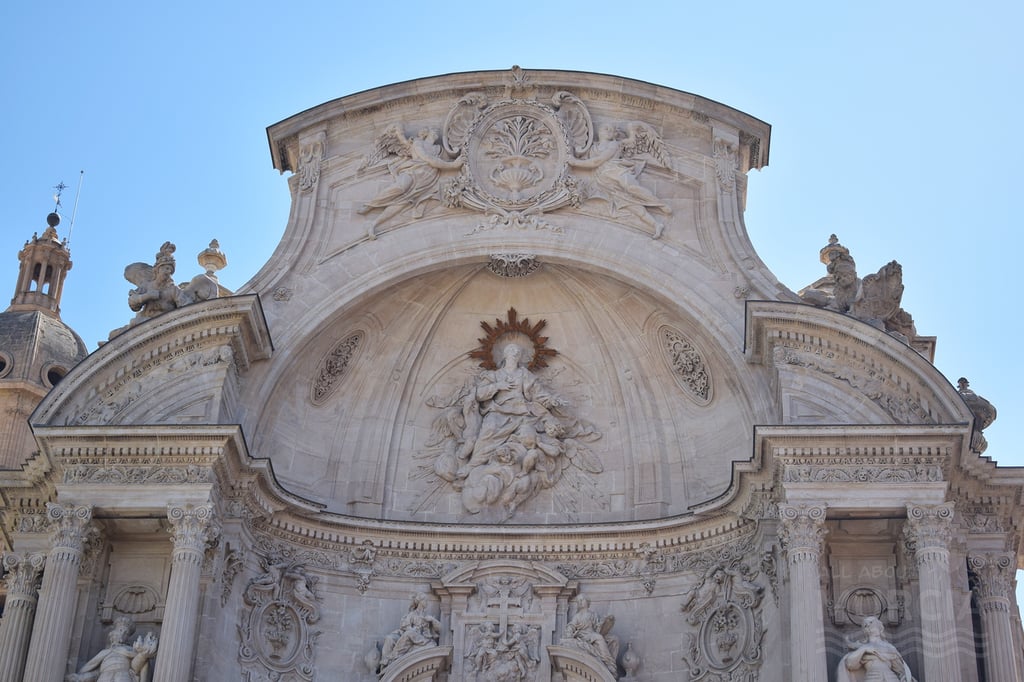
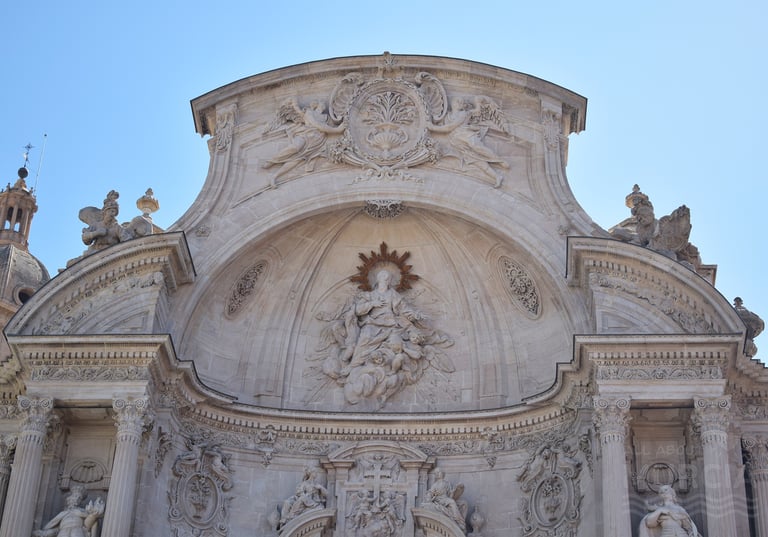
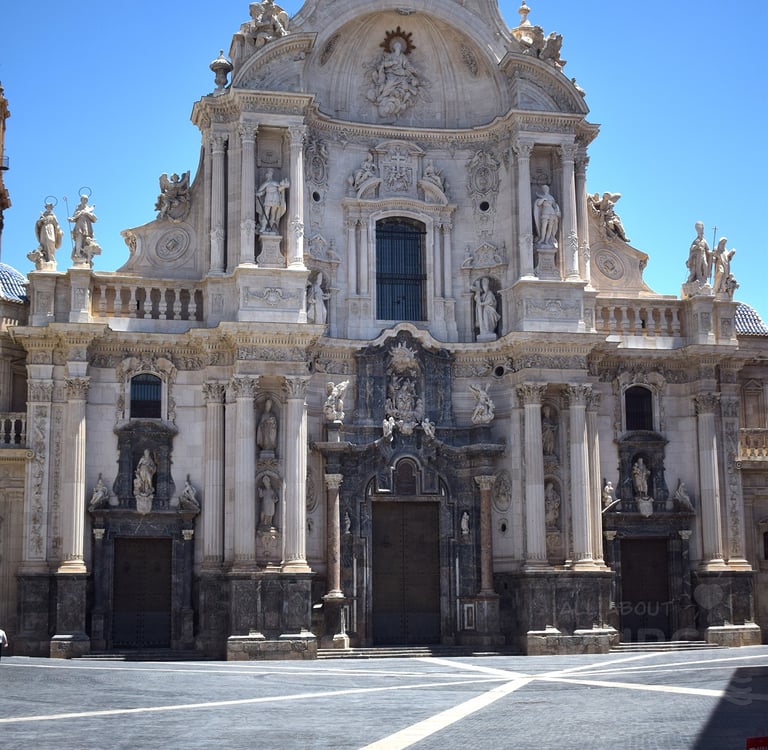
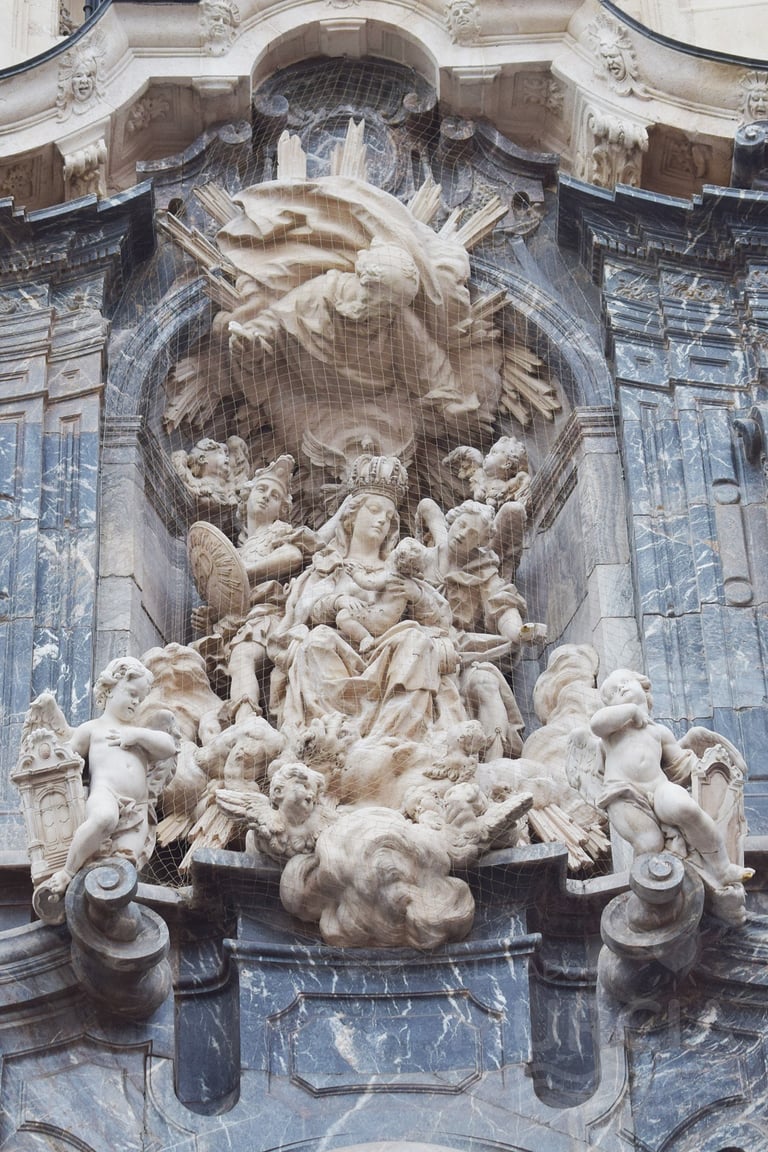
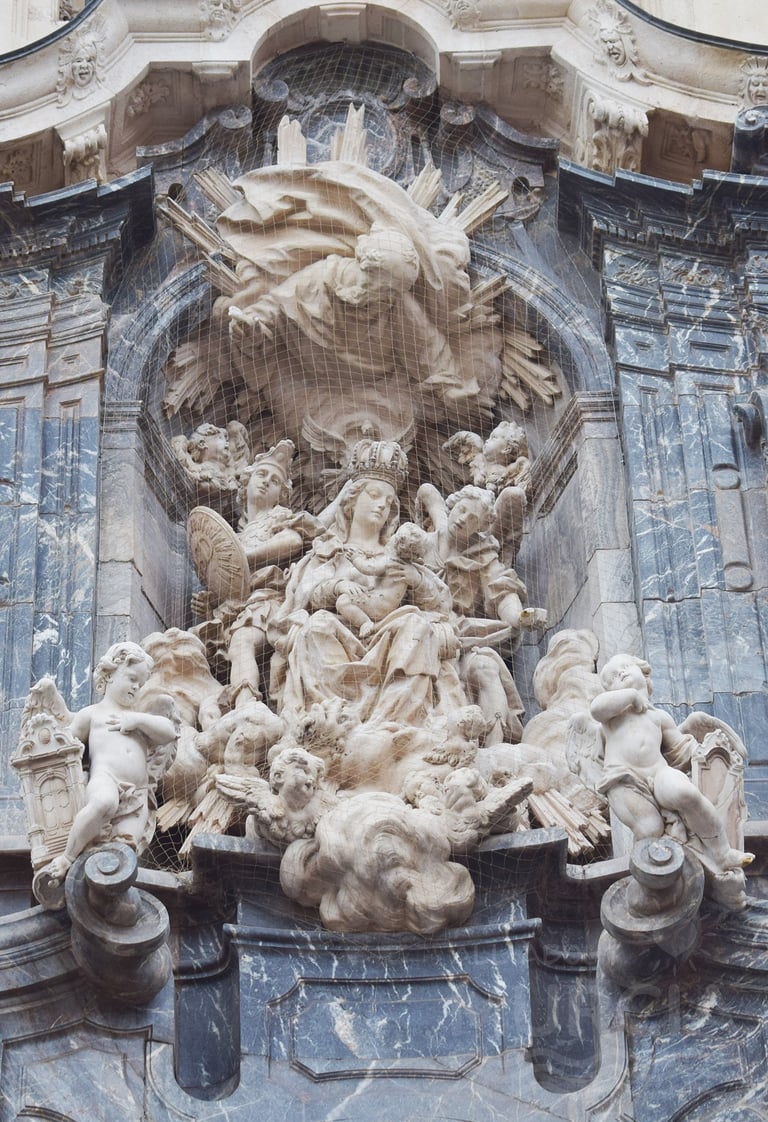
The composition is organized by two large horizontal bodies and three vertical aisles delimited by enormous Corinthian columns. The side aisles are connected to the central one by large volutes that add movement to the whole. The main aisle culminates in a spectacular exedra that houses the relief of the Assumption of the Virgin, the true visual finishing touch of the entire composition.
One of the most successful aspects of the imafronte is the combination of architecture and sculpture. The surfaces advance and retreat through games of concave and convex planes that generate strong chiaroscuro effects. To this is added abundant sculptural decoration integrated in niches, reliefs, medallions, cornices, and friezes, creating a sense of movement and theatricality characteristic of the Baroque.
Different types of stone were employed for its construction primarily sourced from the quarries of Los Garres, Mayayo, and Abanilla. Jaime Bort placed great importance on the surface finishes and the chromatic treatment of the materials, using different polishing and protective techniques that contributed to visually enrich the whole. The bases and some parts of the facades were executed in gray marble, while the rest was made of carefully worked limestone.
The Facade and European Baroque
The facade of the Cathedral of Murcia cannot be understood solely as a work of Spanish baroque. It combines very diverse influences from Italian, French, and Central European architecture, which Jaime Bort integrated with great freedom.
The monumentality of its composition recalls the grand Roman facades of the Baroque, while the use of classical orders and the overall organization of the whole show affinities with 18th-century French architecture. At the same time, the decorative richness and the integration of architecture and sculpture evoke models developed in Sicily and southern Italy. The result is not a copy of any of these traditions, but a deeply original creation that synthesizes multiple influences within its own language.
This capacity for synthesis explains why numerous historians have considered the Murcian imafronte one of the most personal realizations of 18th-century European Baroque.
Reflection of the history of the diocese of Cartagena
If architecture provides the structure of the monument, sculpture brings its meaning. The iconographic program was carefully crafted to present the sacred history of the diocese of Cartagena and reinforce its prestige within the Spanish Church.
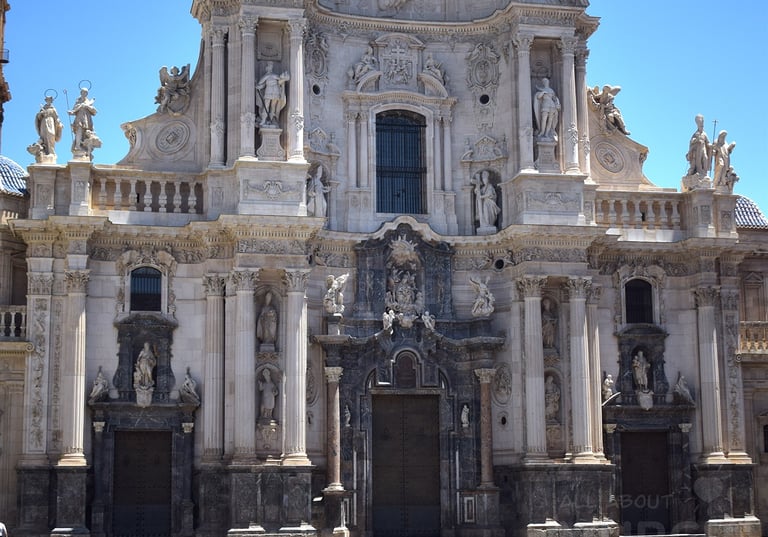
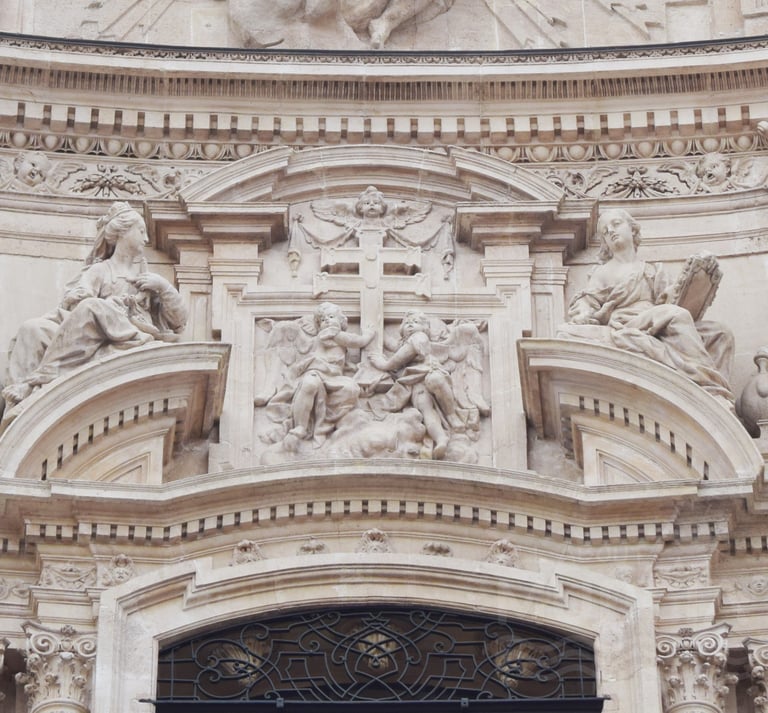
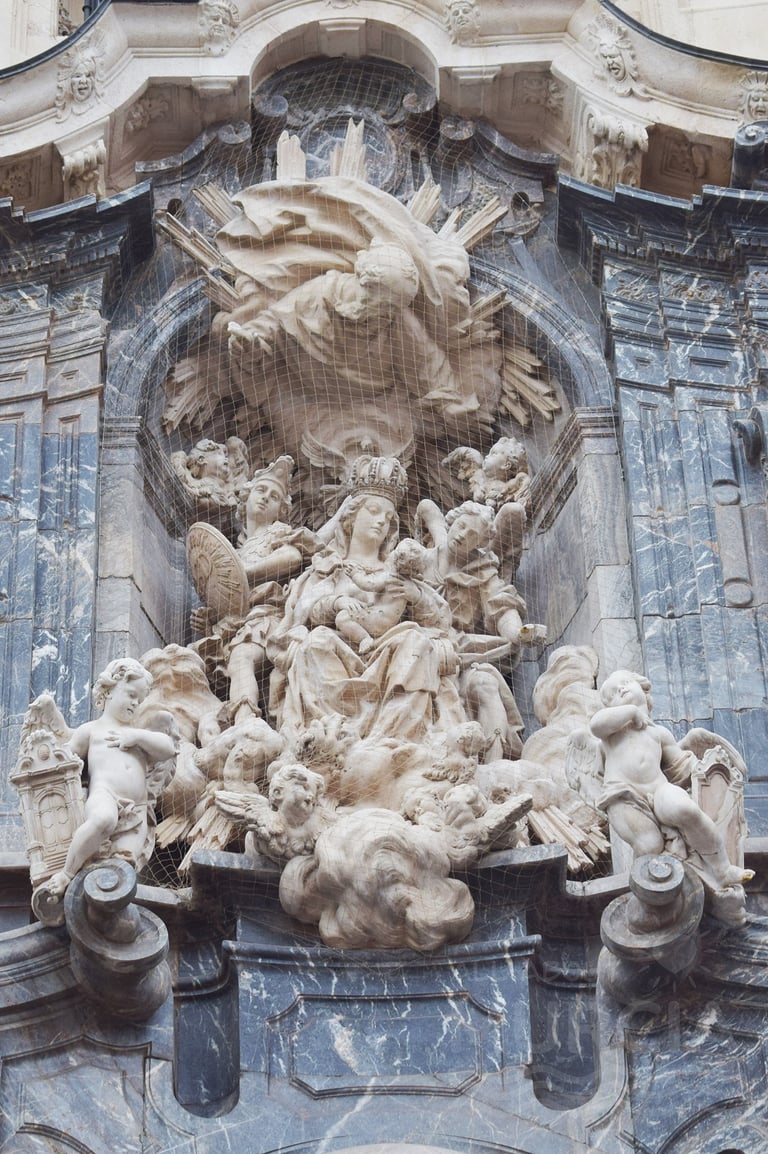
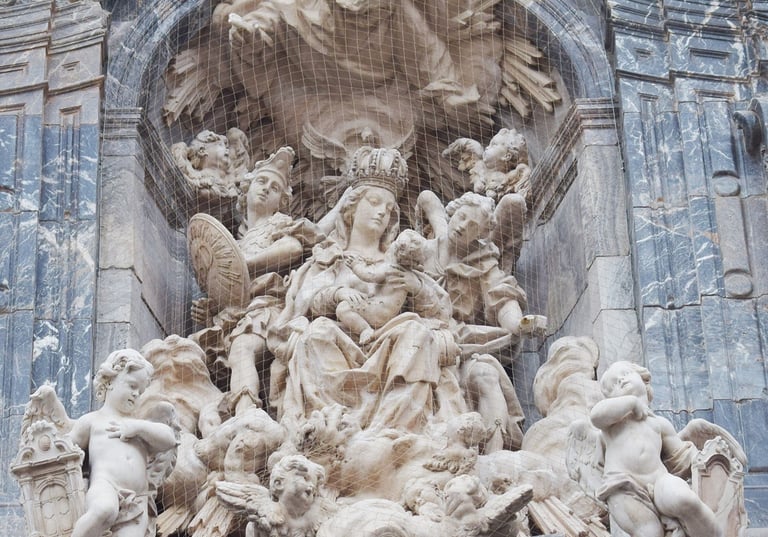
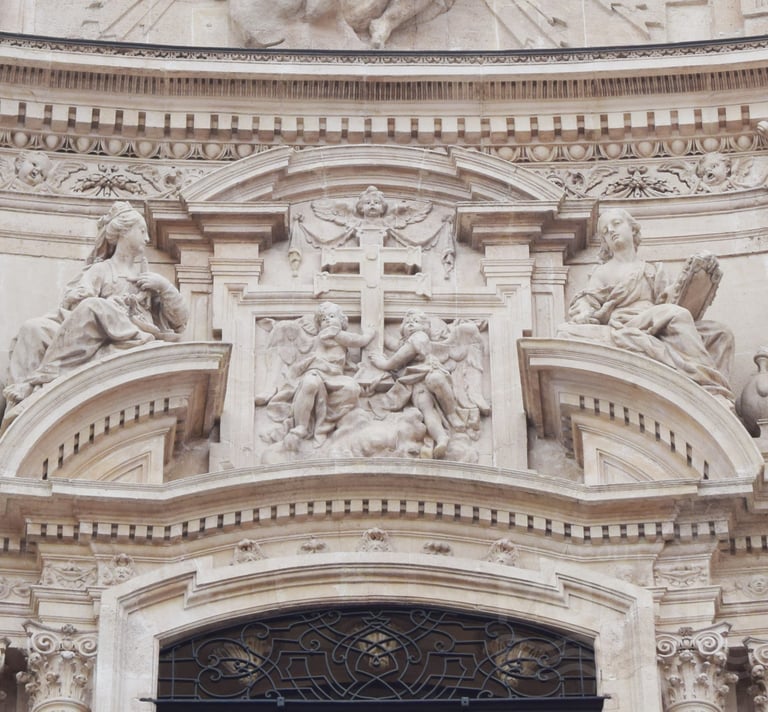
The absolute protagonist is the Virgin Mary, titular of the Cathedral. Her presence dominates the entire composition. In the center of the facade appears the image of the Virgin of the Graces, patroness of the temple, surrounded by angels and archangels. Above her unfolds the great relief of the Assumption, which culminates visually and symbolically the whole. The parents of the Virgin, Saint Joachim and Saint Anne, as well as other Marian episodes, such as the Annunciation or the Immaculate Conception, are also represented in two splendid reliefs on either side of the main entrance.
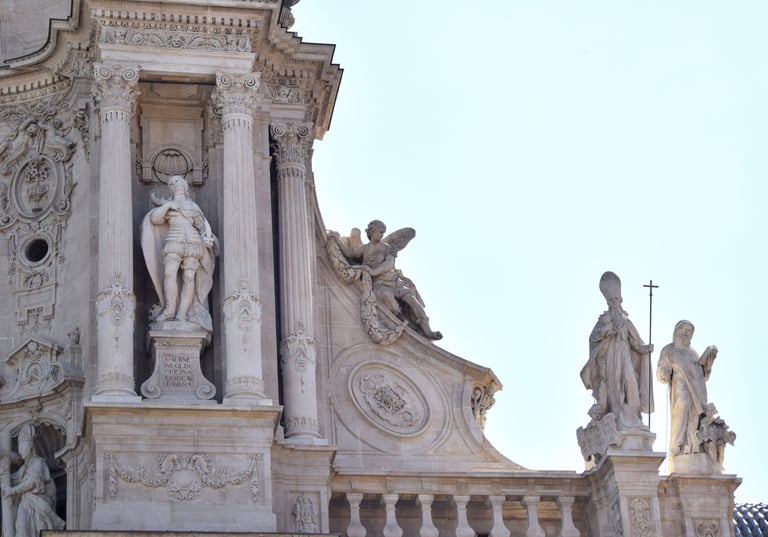
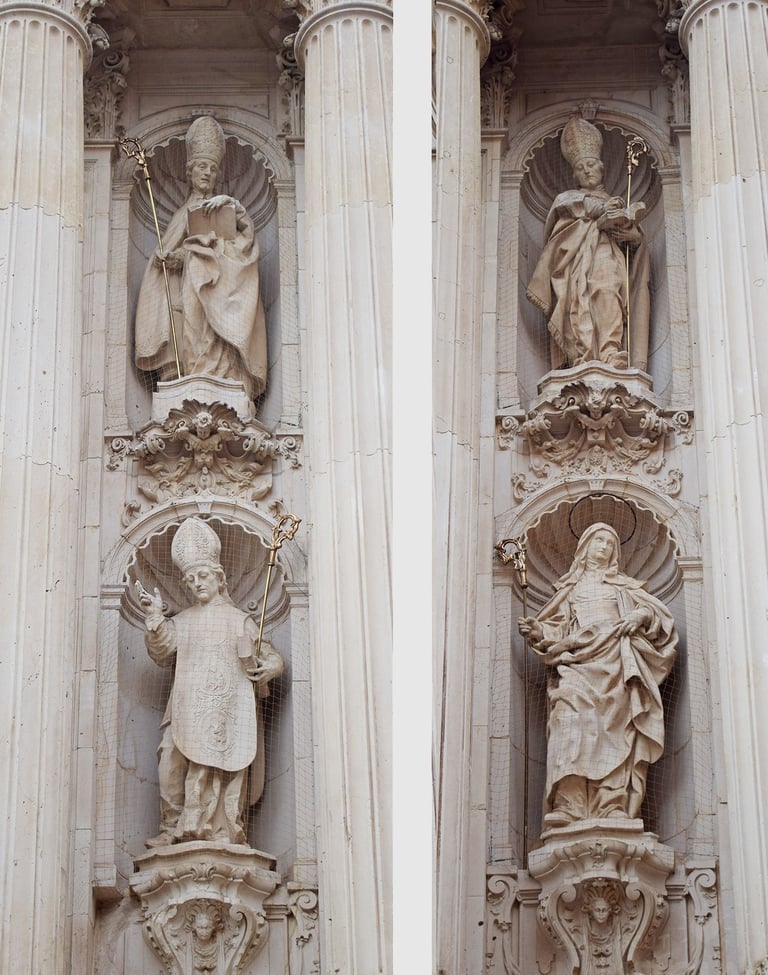
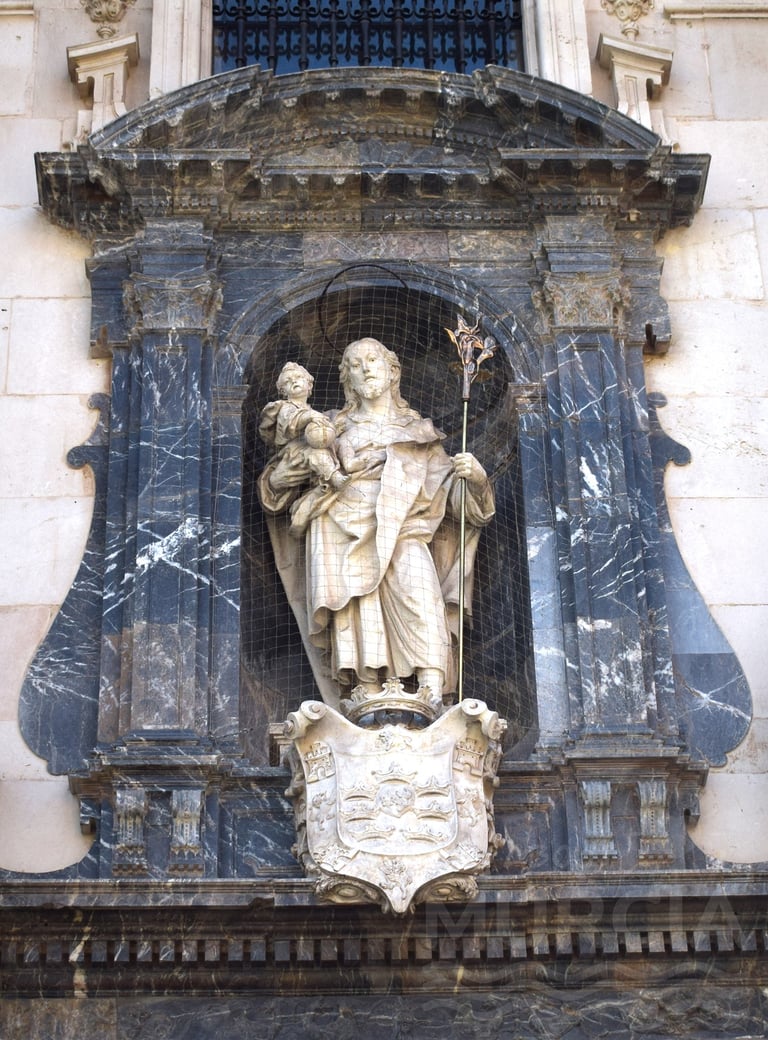
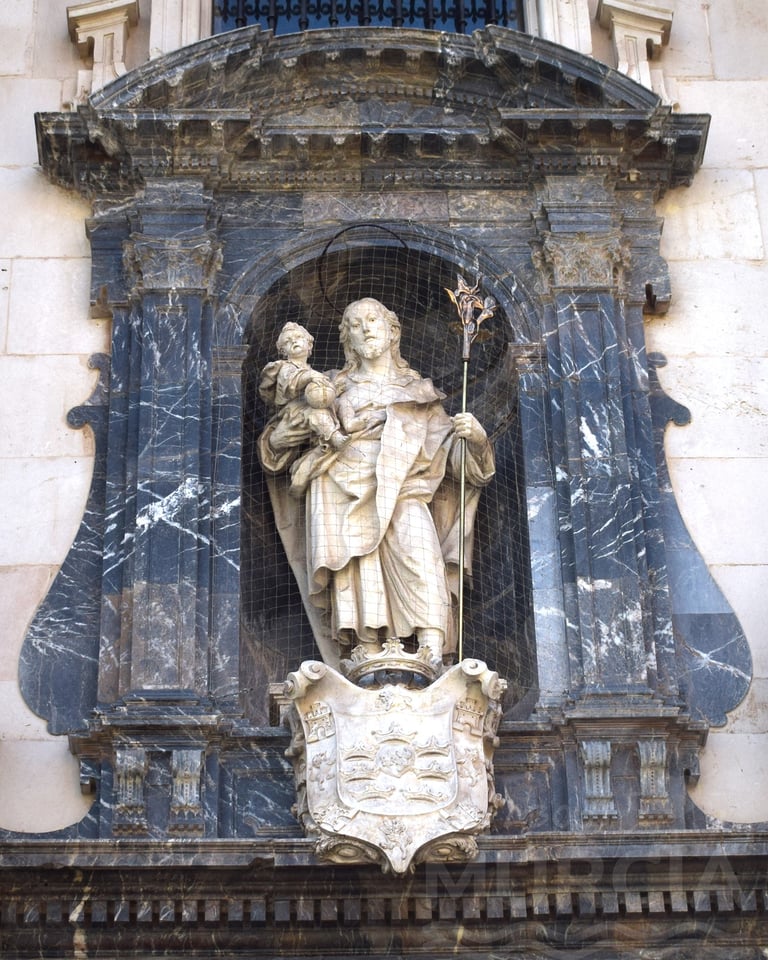
Alongside Mary appear the main saints linked to the diocese. Among them stand out the Four Saints of Cartagena (Saint Fulgencio, Saint Isidore, Saint Leander, and Saint Florentina), fundamental figures in the historical tradition of the old bishopric. Saint Fernando, Saint Hermenegild, Saint Joseph, Saint John the Baptist, and numerous apostles, martyrs, and characters related to the religious history of the region are also represented. The Cross of Caravaca, above the central stained glass, also occupies a prominent place within the iconographic program.
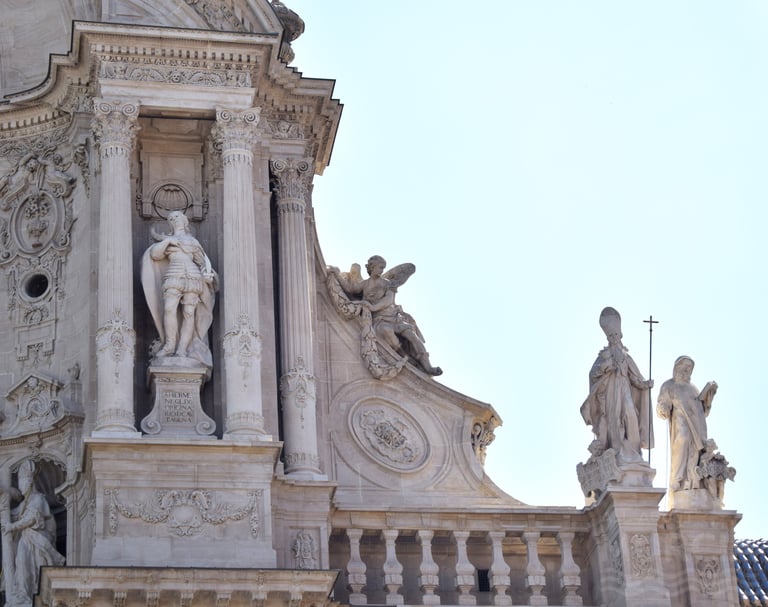
The facade was originally crowned by a monumental sculpture of Saint James the Apostle planting the cross. This image referred to the ancient tradition that the apostle would have arrived in Spain through the port of Cartagena, symbolizing the apostolic origin of the diocese. Although the statue was removed in 1803 for stability reasons, its significance remains essential to understand the overall message of the monument.
A facade with three doors
The three large access doors correspond to the three interior naves of the temple and are part of the symbolic discourse of the facade.
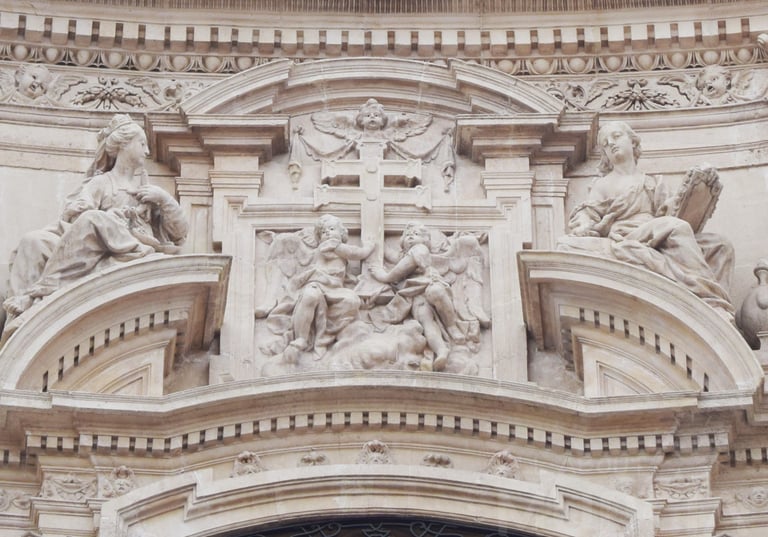
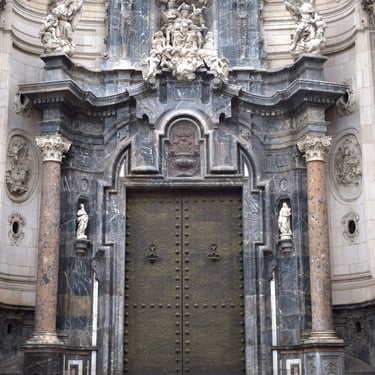
The central door, called the Door of Forgiveness, constitutes the main access; above it is the image of the Virgin of the Graces, emphasizing the Marian character of the Cathedral. Between this sculptural ensemble and the door itself, there is a low relief with a royal crown crowning a jar of lilies. This symbol alludes to the fact that this is the entrance reserved for the king or the royal family. Processions of Corpus Christi or the Virgin of Fuensanta also exit through this door, symbolizing the royalty of Christ and His Mother.
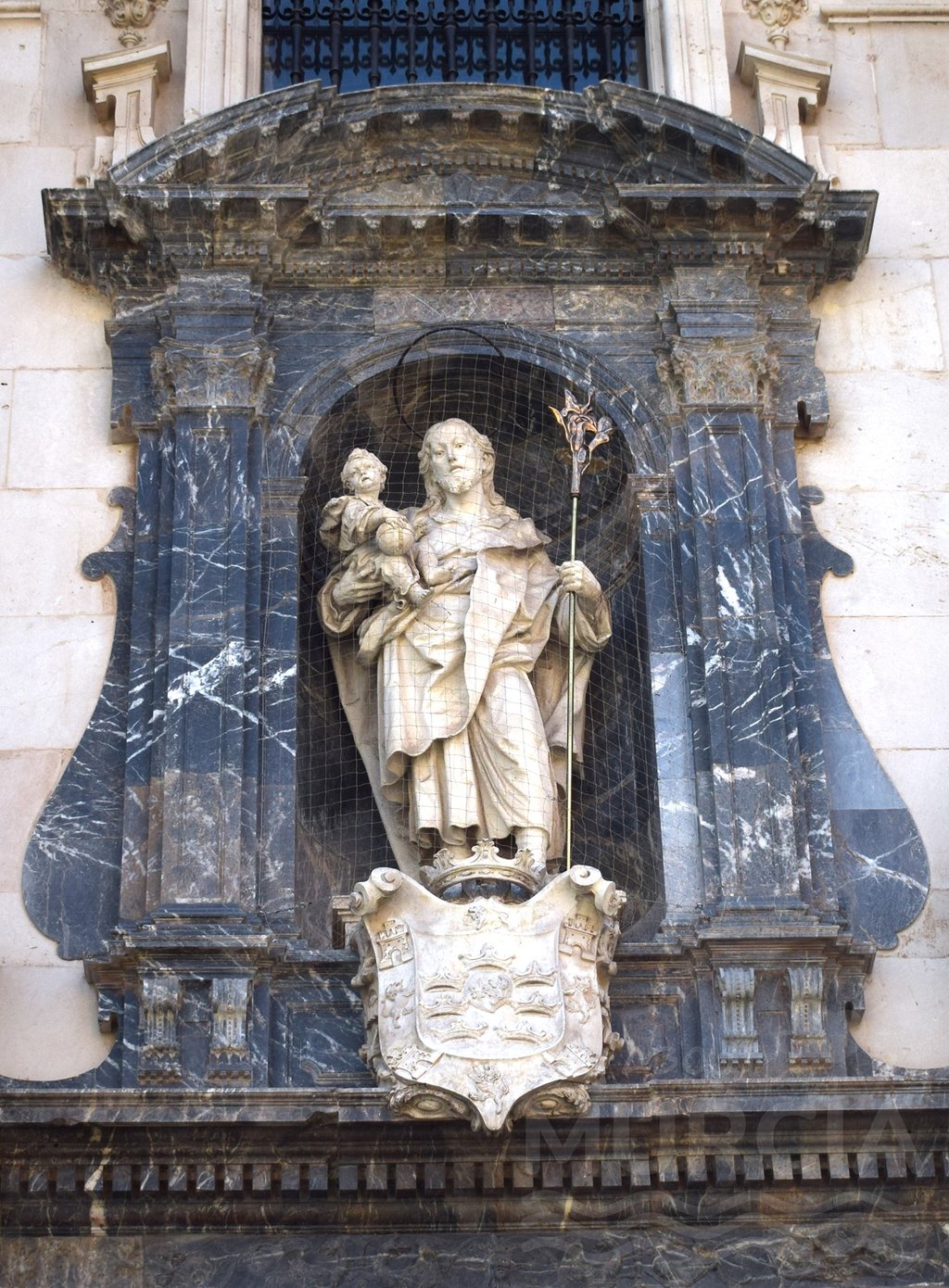
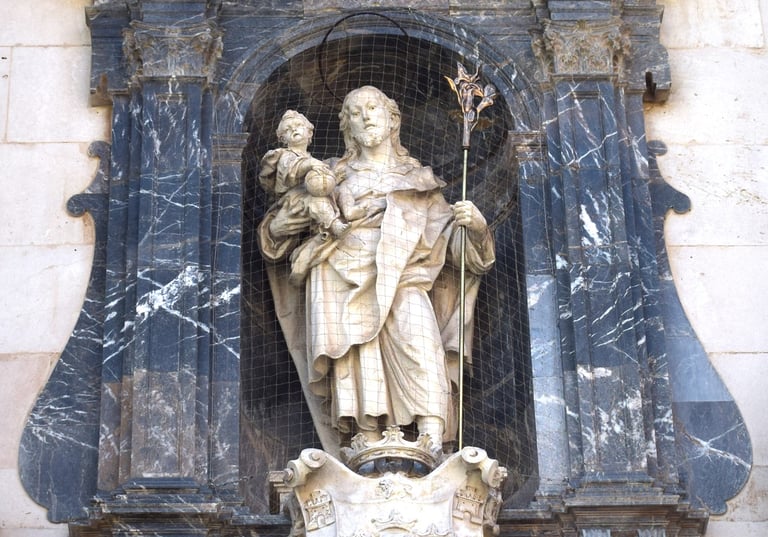
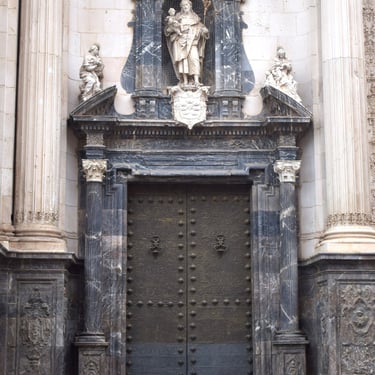
To the right is the Door of Saint Joseph or the Council, linked to Mary's husband and protector of the Holy Family. Above the door we find the coat of arms of the city, as this door was used in certain ceremonies by the mayor and members of the city council.
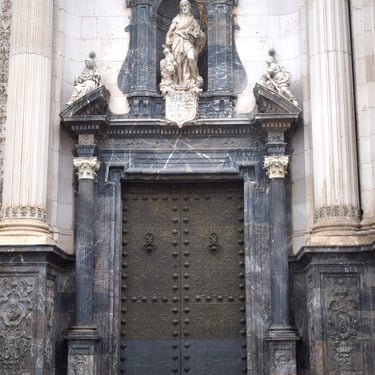
On the opposite side is the Door of Saint John the Baptist or of the Chapter, traditionally reserved for the access of the bishop and members of the cathedral chapter. The shield that appears between the sculpture of the baptist and the door is that of Cardinal Luis Belluga, one of the great sponsors of the construction of this imafronte, as he was sending funds intended for this purpose from Rome.
The great work of Murcian Baroque
The main facade of the Cathedral constitutes the culmination of the baroque architecture developed in Murcia during the 18th century. No other monument in the city brings together with such intensity architecture, sculpture, urbanism, religious symbolism, and historical identity.
In addition to transforming the image of the Cathedral, its construction deeply modified the urban environment and contributed to the creation of the space that today occupies the plaza of Cardinal Belluga. Conceived to dialogue with the city and visually project the spiritual authority of the diocese, the facade continues to fulfill almost three centuries later the function for which it was created: to impress the visitor and present, through an extraordinary artistic language, the history and beliefs of the Church of Cartagena.
Due to its compositional originality, the quality of its execution, and the complexity of its iconographic program, the imafronte of the Cathedral of Murcia occupies a prominent place within European baroque architecture and constitutes one of the most important works of the historical-artistic heritage of the Region of Murcia.
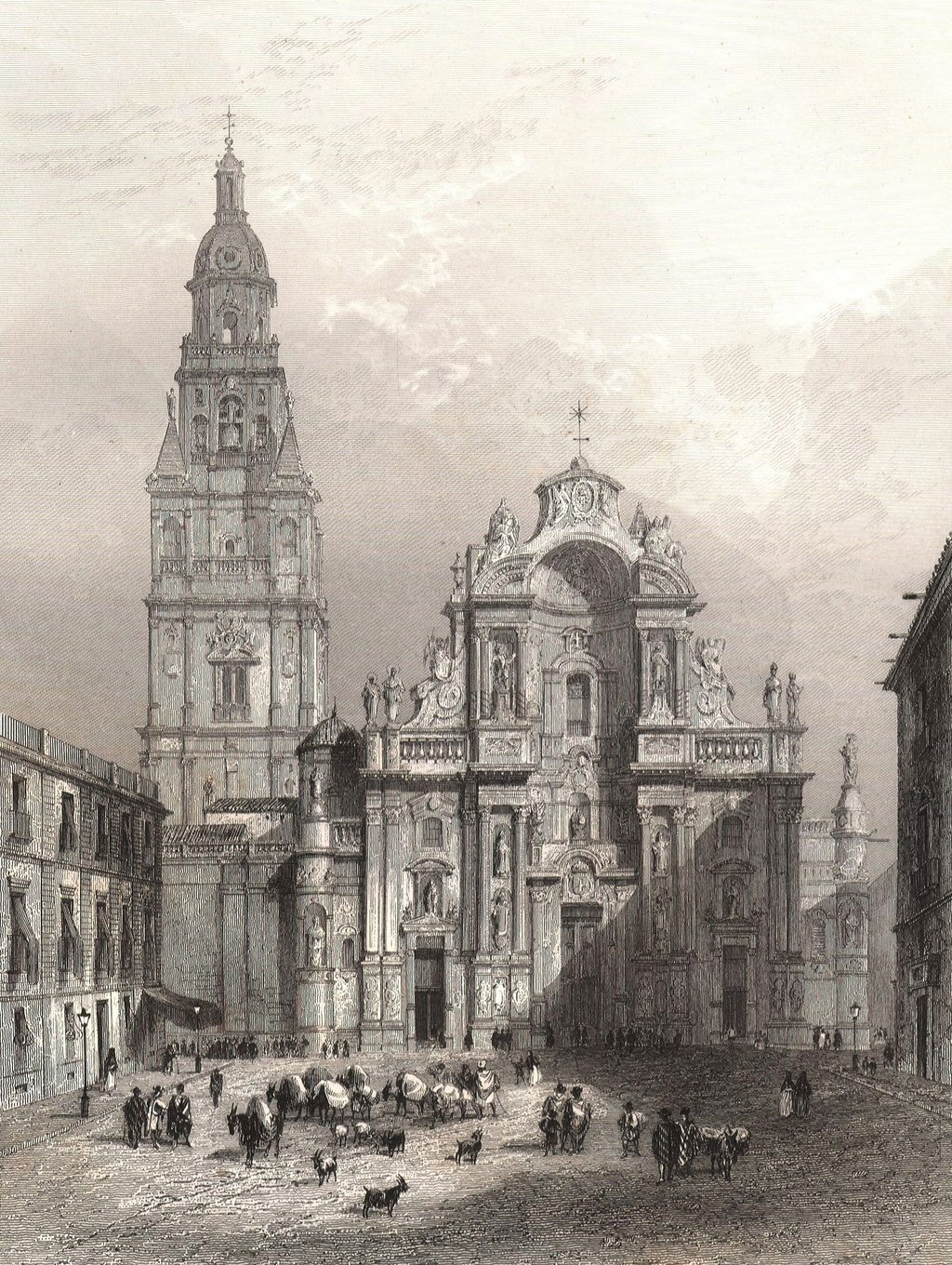
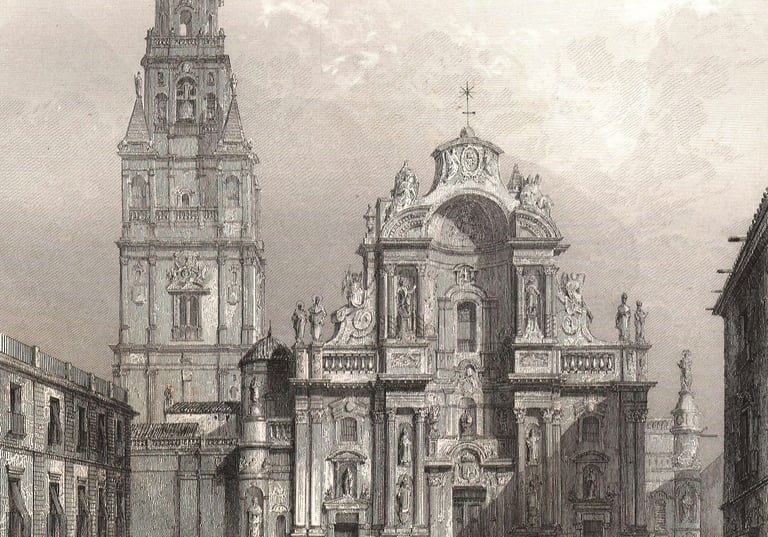
Engraving of the main facade of the cathedral that appeared in the book by Émile Bégin "Voyage pittoresque en Espagne et en Portugal" (1852)
Guided tour of the cathedral of Murcia
The best way to get to know the cathedral of Murcia. A visit of about two hours that covers a complete tour of the exterior and interior of the temple, including its museum. With an official tour guide, a graduate in history and an expert in architecture and historical heritage.
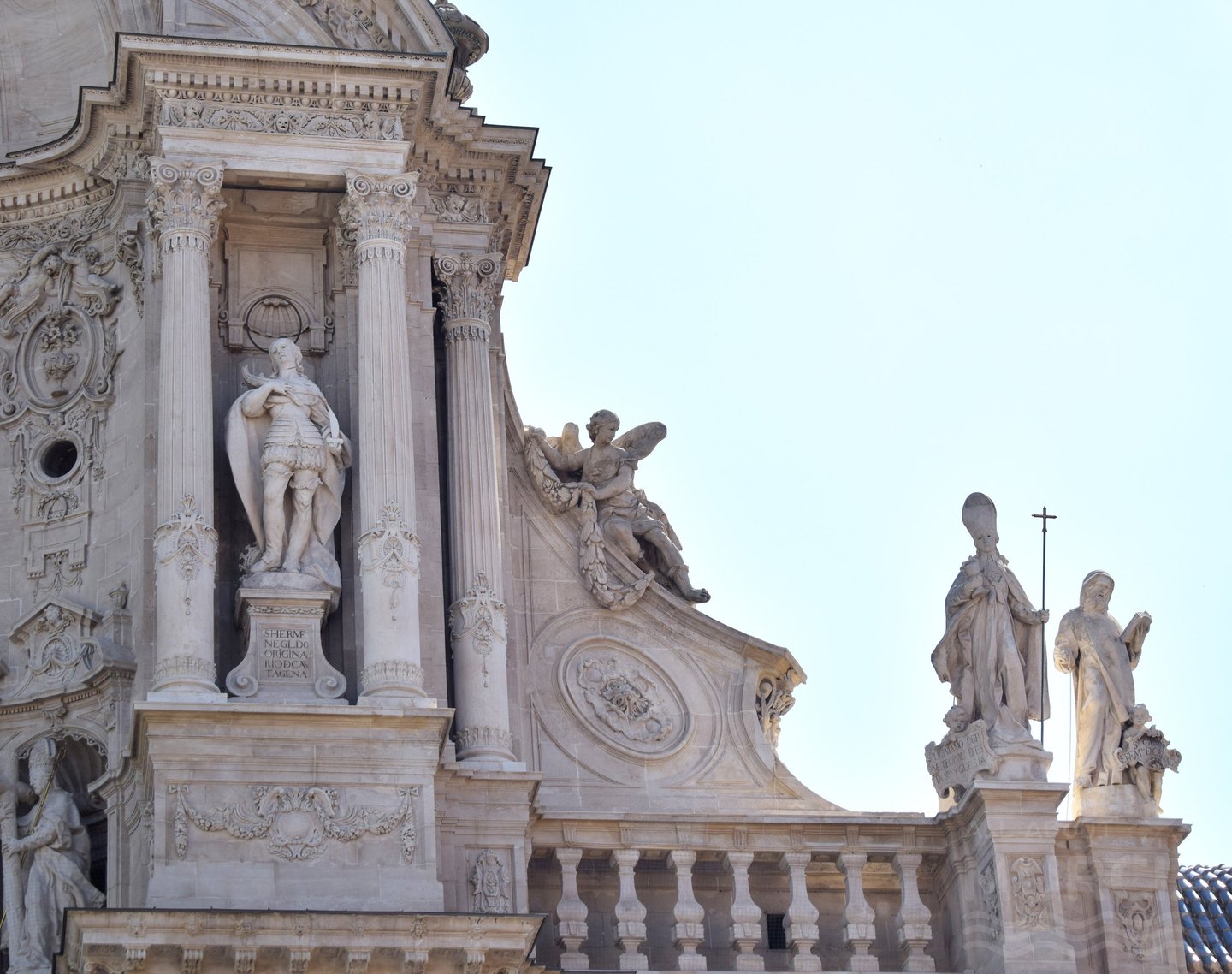
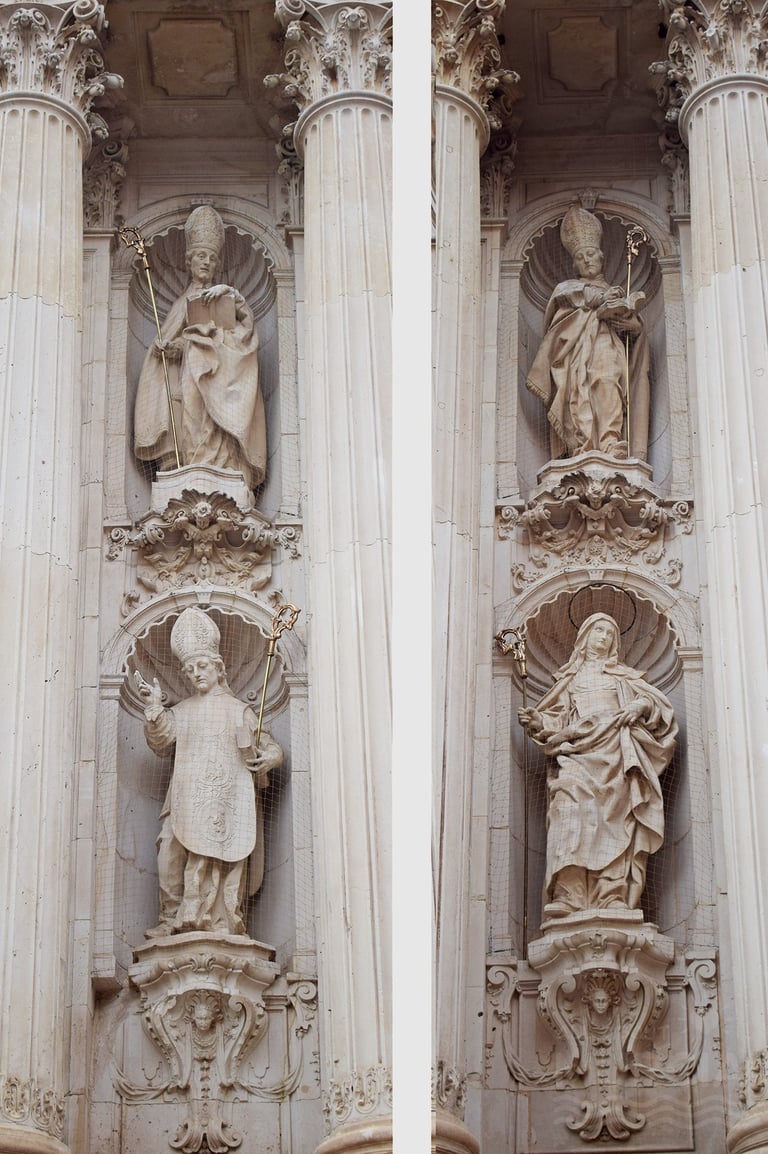
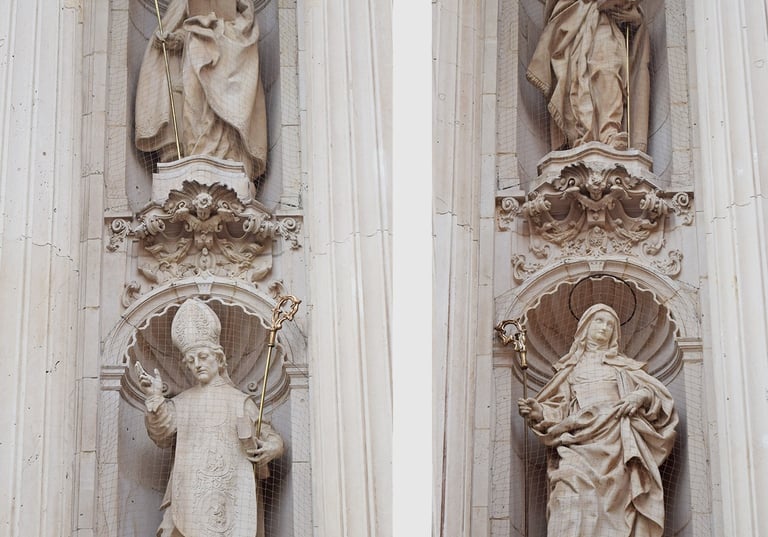
The "four saints of Cartagena" flank the main door: on the left saint Leandro and saint Fulgencio, and on the right saint Isidore and saint Florentina.
Guided tour of the cathedral of Murcia
The best way to get to know the cathedral of Murcia. A tour of about two hours that makes a complete tour of the exterior and interior of the temple, including its museum. With an official tourism guide, graduated in history and an expert in architecture and historical heritage.
The facade of the Murcia Cathedral
The splendid main facade of the Murcia Cathedral is in itself an expression of the apotheosis of baroque art, not only at the regional or national level but even at the European level. Generally known as "imafronte", a term used to refer to the "facade that rises at the feet of a church or a cathedral, opposite to the head."
The imafronte of the Murcia Cathedral presents a monumental baroque composition that was conceived not only as the main entrance to the temple but also as a great visual proclamation of the identity of the diocese of Cartagena. Its extraordinary architectural and sculptural richness has made it one of the most recognizable creations of Spain's heritage and the most emblematic image of the city of Murcia, along with the tower of the same cathedral.
In this article, we will try to expose the most interesting aspects of this colossal work. But if you want to know in depth not only the imafronte but also the entire cathedral complex, the best option is our guided tour of the Murcia Cathedral. A tour of about two hours through the exterior and interior of the cathedral, including its museum, led by an official guide expert in history, architecture, and historical heritage. Do not hesitate to contact to reserve or request more information.
History of its construction
The current facade replaced another previous one built in the 16th century under the direction of Jerónimo Quijano. At the beginning of the 18th century, that Renaissance doorway presented serious structural problems caused by frequent earthquakes and by the floods that periodically affected the city. After various technical reports, including those drawn up by military engineer Sebastián Feringán, the cathedral chapter decided to adopt a radical solution: completely demolish the old western front and raise a new facade in accordance with the importance of the cathedral's main temple.
The demolition began in 1732, although the works on the new facade did not start until 1737. The commission fell to Jaime Bort, an architect and sculptor born in the ancient Kingdom of Valencia, whose artistic personality would decisively mark the final result. For more than a decade, he personally directed the extraction of materials, architectural design, organization of workshops, and execution of sculptures. Under his orders worked numerous stonemasons, sculptors, and craftsmen, including Vicente Bort, Manuel Bergaz, Jaime Campos, and Pedro Fernández. When Jaime Bort was called to Madrid in 1748, the direction passed to Pedro Fernández, who completed the work in 1754.
The preserved documentation indicates that the project conceived by Jaime Bort was even more ambitious than the facade ultimately executed. Various decisions made during the final phase of the works led to modifications of the originally planned design and the suppression of one of the bodies contemplated in the original trace, although the disappearance of the drawings of the project prevents reconstructing its definitive appearance with precision.
A great stone retable
The facade was conceived as a gigantic urban retable oriented towards the current plaza del Cardenal Belluga. Its function went far beyond simple protection of the access to the temple: it had to impress the visitor, convey the main messages of the Catholic faith, and exalting the history of the diocese.
The composition is organized through two large horizontal bodies and three vertical streets delimited by enormous Corinthian columns. The side streets are joined to the central one by large volutes that bring movement to the whole. The main street culminates in a spectacular exedra that houses the relief of the Assumption of the Virgin, the true visual finish of the entire composition.
One of the most successful aspects of the imafronte is the combination of architecture and sculpture. The surfaces advance and recede through games of concave and convex planes that generate strong chiaroscuro effects. In addition, there is an abundant sculptural decoration integrated into niches, reliefs, medallions, cornices, and entablatures, creating a sense of movement and theatricality characteristic of Baroque art.
For its construction, different types of stone were used, mainly from the quarries of Los Garres, Mayayo, and Abanilla. Jaime Bort placed great importance on surface finishes and the chromatic treatment of materials, using different polishing and protection techniques that enriched the visual appearance of the ensemble. The bases and some parts of the doorways were executed in gray marble, while the rest was made of carefully worked limestone.
The imafronte and European Baroque
The facade of the Cathedral of Murcia cannot be understood merely as a work of Spanish baroque. It brings together very diverse influences from Italian, French, and Central European architecture, integrated with great freedom by Jaime Bort.
The monumentality of its composition recalls the great Roman facades of Baroque art, while the use of classical orders and the general organization of the whole show affinities with French architecture of the 18th century. At the same time, the decorative richness and the integration between architecture and sculpture evoke models developed in Sicily and southern Italy. The result is not a copy of any of these traditions, but a deeply original creation that synthesizes multiple influences within its own language.
This capacity for synthesis explains why many historians have considered the Murcia imafronte one of the most personal realizations of European Baroque art of the 18th century.
Reflection of the history of the diocese of Cartagena
If architecture provides the structure of the monument, sculpture provides its meaning. The iconographic program was carefully crafted to present the sacred history of the diocese of Cartagena and reinforce its prestige within the Spanish Church.
The absolute protagonist is the Virgin Mary, the titular of the Cathedral. Her presence dominates the entire composition. In the center of the facade appears the image of the Virgen de las Gracias, patroness of the temple, surrounded by angels and archangels. Above her develops the great relief of the Assumption, which visually and symbolically culminates the whole. The parents of the Virgin, Saint Joachim and Saint Anne, are also represented, along with other Marian episodes, such as the Annunciation or the Immaculate Conception, depicted in two splendid reliefs on either side of the main entrance.
Alongside Mary appear the main saints linked to the diocese. Among them stand out the Four Saints of Cartagena (Saint Fulgentius, Saint Isidore, Saint Leander, and Saint Florentina), fundamental figures in the historical tradition of the old bishopric. Saints Ferdinand, Hermenegild, Joseph, John the Baptist, and numerous apostles, martyrs, and characters related to the religious history of the region are also represented. The Cross of Caravaca, on the central stained glass, also occupies a prominent place within the iconographic program.
The facade was originally crowned by a monumental sculpture of Saint James the Apostle planting the cross. This image referred to the ancient tradition that the apostle would have arrived in Hispania through the port of Cartagena, symbolizing the apostolic origin of the diocese. Although the statue was removed in 1803 for stability reasons, its significance remains essential for understanding the overall message of the monument.
A facade with three doors
The three large access doors correspond to the three interior naves of the temple and are part of the symbolic discourse of the facade.
The central door, called the Door of Forgiveness, constitutes the main access over which the image of the Virgen de las Gracias is located, emphasizing the Marian character of the Cathedral. Between this sculptural group and the door itself, we find a low relief with a royal crown crowning a vase of lilies. This symbol alludes to the fact that this is the entrance reserved for the king or the royal family. Processions for Corpus Christi or for the Virgen de la Fuensanta also exit from this door, symbolizing the royalty of Christ and His Mother.
On the right is the Door of Saint Joseph or the Council, linked to the husband of Mary and protector of the Holy Family. Above the door, we find the city’s coat of arms, since this door was used in certain ceremonies by the mayor and the members of the city council.
On the opposite side opens the Door of Saint John the Baptist or the Chapter, traditionally reserved for the access of the bishop and members of the cathedral chapter. The coat of arms that appears between the sculpture of the Baptist and the door is that of Cardinal Luis Belluga, one of the great sponsors of the construction of this imafronte, as he was sending funds intended for this purpose from Rome.
The great work of Murcian Baroque
The main facade of the Cathedral constitutes the culmination of Baroque architecture developed in Murcia during the 18th century. No other monument in the city brings together with such intensity architecture, sculpture, urbanism, religious symbolism, and historical identity.
In addition to transforming the image of the Cathedral, its construction profoundly altered the urban environment and contributed to the creation of the space that today occupies the plaza del Cardenal Belluga. Designed to engage with the city and visually project the spiritual authority of the diocese, the facade continues to fulfill, almost three centuries later, the purpose for which it was created: to impress the visitor and to present, through an extraordinary artistic language, the history and beliefs of the Church of Cartagena.
Due to its compositional originality, the quality of its execution, and the complexity of its iconographic program, the imafronte of the Cathedral of Murcia occupies a prominent place within European Baroque architecture and constitutes one of the most important works of the historical-artistic heritage of the Region of Murcia.
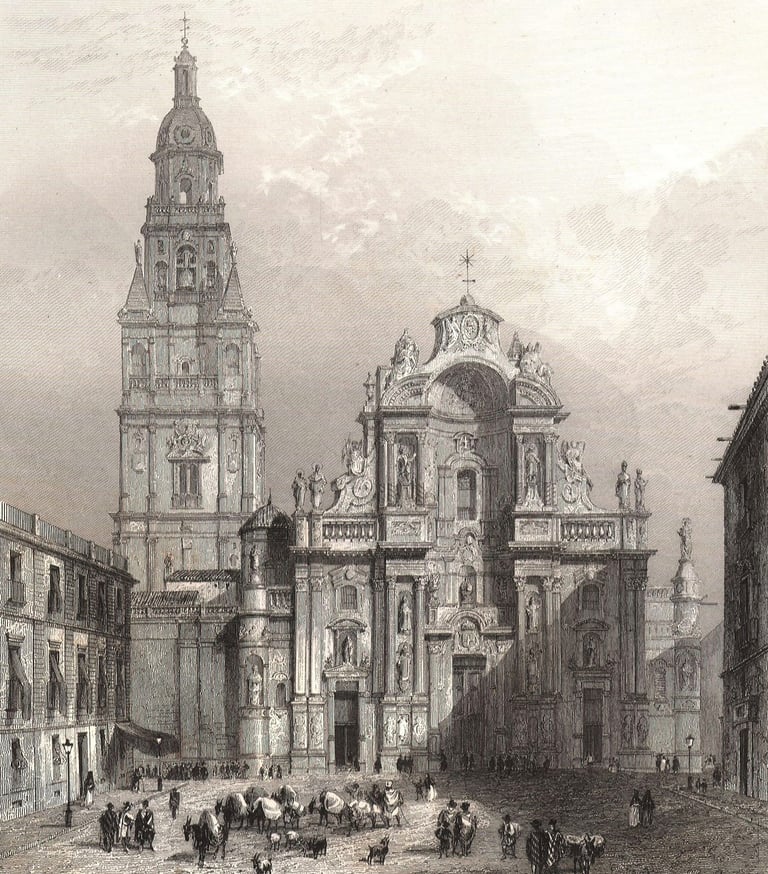
Engraving of the main facade of the cathedral that appeared in the book by Émile Bégin "Voyage pittoresque en Espagne et en Portugal" (1852)
Visita guiada a la catedral de Murcia
La mejor manera de conocer la catedral de Murcia. Una visita de unas dos horas que hacer un recorrido completo por el exterior e interior del templo, incluyendo su museo. Con guía oficial de turismo, graduado en historia y experto en arquitectura y patrimonio histórico.
Los "cuatro santos de Cartagena" flanquean la puerta principal: a la izquierda san Leandro y san Fulgencio, y a la derecha san Isidoro y santa Florentina.
Visita guiada a la catedral de Murcia
La mejor manera de conocer la catedral de Murcia. Una visita de unas dos horas que hacer un recorrido completo por el exterior e interior del templo, incluyendo su museo. Con guía oficial de turismo, graduado en historia y experto en arquitectura y patrimonio histórico.


